Artificial Intelligence (AI) in business refers to machine-driven systems that analyze data, recognize patterns, generate forecasts, assist with decision-making, and create content. These systems operate on extensive datasets and process information significantly faster than manual analysis.
AI technologies, including machine learning, natural language processing, computer vision, and large-scale data analytics, enable applications to replicate or surpass certain aspects of human intelligence and judgement within defined parameters.
In the context of business management, AI is employed to enhance decision-making, automate operations, and optimize outcomes. However, ultimate accountability and oversight remain the responsibility of human leadership, as consistently noted in recent industry reports and academic literature.
Artificial Intelligence has become the centrepiece of strategic decision-making and is disrupting the way industries function — from sales and marketing to finance and HR — giving companies a competitive edge. AI is no longer a question of “if” but “how soon” and “how deeply” it will be integrated because AI Outperforms Traditional Business Intelligence BI Charts and dashboards which are useful tools, but they often struggle to analyze big and complex datasets. AI outperforms the traditional Business Intelligence approach by going beyond correlation to identify causation — helping companies build customer retention models, optimize pricing, minimize costs, and run organizations more effectively.
According to industry analysis, *Advanced Analytics is the umbrella term for a variety of underlying technologies, whereas AI is considered a subset of advanced analytics that focuses specifically on systems capable of autonomous inference, learning, and decision-making.
However, in practice, the two are often discussed as distinct paradigms because they differ fundamentally in how they arrive at business decisions. * Advance Analytic beyond BI is for Diagnostic, Descriptive, Predictive, Causal and Prescriptive Analysis.
The EU AI Act formally defines an AI system as one that has the “capability to infer” — meaning it can derive models or algorithms from inputs/data, enabling learning, reasoning, or modelling that “transcends basic data processing.” AI systems also exhibit “varying levels of autonomy” and “self-learning capabilities, allowing the system to change while in use”.
Artificial intelligence systems are valued for their low human involvement, adaptability, self-learning abilities, and inference capabilities, enabling them to learn autonomously from data or models. So, AI is rapidly transforming business management across all functions — from operations and finance to marketing and customer service — and organizations that strategically adopt AI are gaining measurable competitive advantages, though success requires moving from ambition to activation.
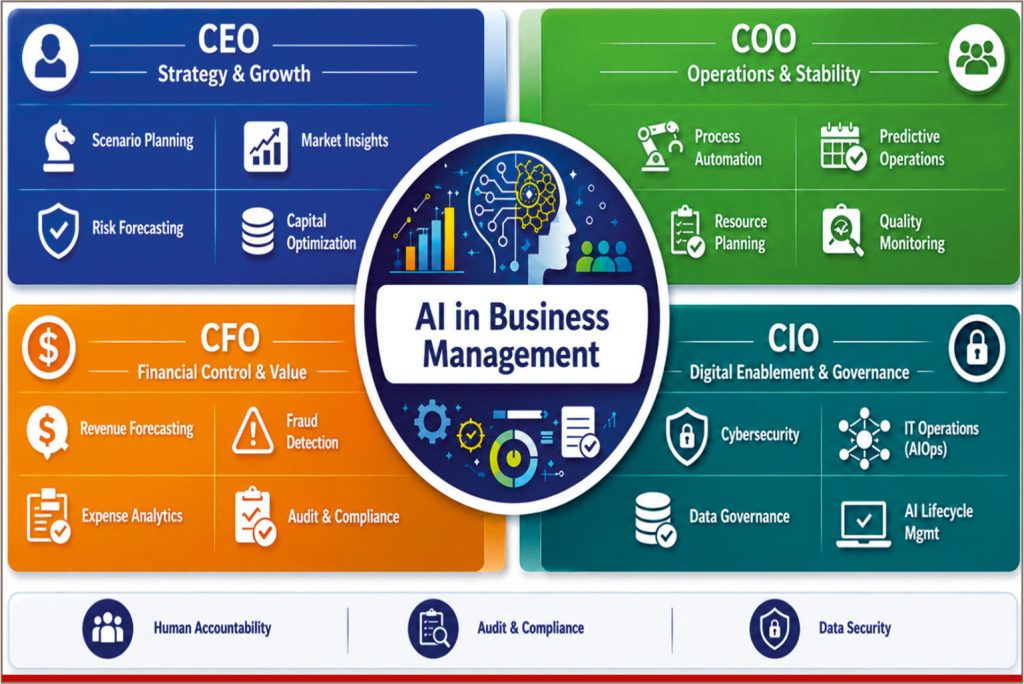
Artificial Intelligence should be adopted as a management enablement capability, not as a standalone technology initiative. Its primary role in the enterprise is to improve decision quality, accelerate execution, optimize value, and reduce risk, while final accountability remains firmly with business leaders. AI advantages for the CXO level and Management level are beyond the verbatim in strategy notes, proposals, operating model sections, or executive emails.
- COO – Operations, Execution & Stability: Predictive Operations Management, Process Optimization & Automation, AI-Driven Scheduling & Resource Planning, Quality & Defect Prediction, AIOps (IT + Ops).
Control Principle: AI supports judgment, not vision. Final strategic decisions remain human-owned.
- COO – Operations, Execution & Stability: Predictive Operations Management, Process Optimization & Automation, AI-Driven Scheduling & Resource Planning, Quality & Defect Prediction, AIOps (IT + Ops).
Control Principle: AI operates within defined thresholds exceptions escalate to human control.
- CFO – Financial Control, Value & Risk: Cash-Flow & Revenue Forecasting, Expense & Spend Analytics, Fraud & Anomaly Detection, Investment ROI Tracking, Regulatory & Audit Intelligence.
Control Principle: AI recmmendations must be auditable, explainable, and evidence-backed. - CIO – Digital Enablement, Governance & Risk: Decision Intelligence Platforms, IT & Application Operations (AIOps), Cybersecurity Intelligence, Data Quality & Governance Automation, AI Governance & Lifecycle Management.
- Control Principle: CIO owns AI platforms, data, and guardrails—not business decisions
Written by
Anand Kumar is a distinguished Enterprise Architect and techno-business leader with 20+ years of experience driving digital transformation across BFSI, Telecom, Manufacturing, IoT, Power, and Public Sector domains. At DXC Technology, he has led USD 100M+ programs in digital banking, AI/ML, cloud, analytics, cybersecurity, and enterprise platforms, including a key role in building India Post Payments Bank. His expertise includes Blockchain, Big Data, IoT, microservices, APIs, and cloud-native architectures on AWS, Azure, and GCP. He holds credentials from Indian Institute of Technology Kanpur along with certifications such as TOGAF 9, PMP, AWS Solutions Architect, and CEBA.