
The recognition question: is a PGDM equivalent to an MBA?
This is the question that worries most applicants from non-IIM backgrounds, and it deserves a precise answer rather than vague reassurance.
For private-sector employment
In most private-sector hiring in India, recruiters evaluate candidates by institution quality, specialisation relevance, internship performance, and the demonstrated skill set, not by whether the credential is a degree or a diploma. India’s most respected business schools, including the IIMs, XLRI, MDI, SPJIMR, and IIFT, award PGDM programs. The entire private-sector recruiting apparatus has evolved to treat PGDM from a credible AICTE-approved institution as equivalent to MBA for employment purposes.
For higher studies, including PhD programs
The Association of Indian Universities (AIU) accords equivalence to two-year full-time PGDM programs from AICTE-approved and NBA-accredited institutions, treating them as equivalent to a Master’s degree for the purpose of higher education admission. However, individual universities have their own eligibility requirements for doctoral programs. Students planning to pursue a PhD after their PGDM should check the specific requirements of their target institutions. This is an area where MBA carries a marginal structural advantage.
For international recognition
For students planning to work or study abroad, international employers and universities increasingly evaluate qualifications on the basis of the institution’s reputation, accreditation (such as AACSB, AMBA, or EQUIS), and the candidate’s demonstrated competencies. Top Indian PGDM programs from well-accredited institutions are well-recognised internationally. Students should verify specific requirements for their target countries.
Curriculum flexibility: the most important difference in 2026
If the recognition question is about the credential, the curriculum question is about what you actually learn. And on this dimension, the difference between MBA and PGDM programs is significant and consequential.
How MBA curricula are updated
A university-affiliated MBA follows a syllabus revised through its academic bodies on a cycle that typically takes three to five years. Strong faculty bring contemporary thinking into the classroom regardless, but any formal change, whether introducing a new subject, integrating a new technology, or replacing an outdated specialisation, requires institutional approval that takes time.
How PGDM curricula are updated
An autonomous PGDM institution can update its curriculum at the end of any trimester and implement the change in the next cohort. When data analytics became business-critical in 2019, forward-looking PGDM programs had it integrated within months. When generative AI became an industry reality in 2023, autonomous programs responded immediately. University-affiliated MBA programs began the approval process.
Curriculum flexibility: the most important difference in 2026
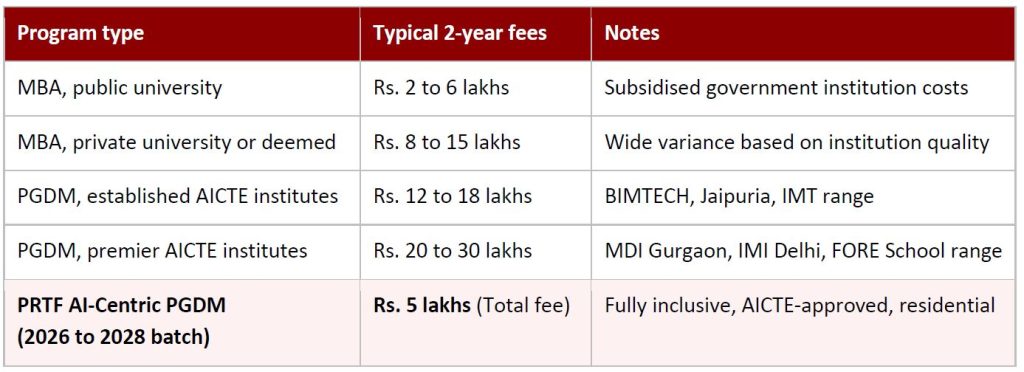
Fee ranges across program types (2026)
Salary outcomes: what actually drives them
This is the part most PGDM vs MBA articles get wrong. They pit the credential against each other and imply that one consistently pays more than the other. The data does not support this.
The IMS India analysis of 2025 placement data found that no measurable salary difference exists between PGDM and MBA graduates when controlling for institution quality. SP Jain (PGDM) graduates average approximately Rs. 33 lakhs, while IIM Bangalore (MBA) graduates average approximately Rs. 35 lakhs. The gap is negligible, and is explained by institutional tier and recruiter mix, not by the credential type.
What actually determines starting salary:
- Institution tier and brand equity. The most reliable predictor of salary outcome.
- Specialisation choice. Marketing and finance specialisations are showing the fastest salary growth in 2026, with analytics specialisations seeing 20 to 25% year-on-year increases according to MGI research.
- Internship and placement performance. Students who convert internships into PPOs consistently outperform those who enter the formal placement cycle.
- AI and digital skills. Recruiters in 2026 are placing measurable salary premiums on candidates with demonstrated AI literacy. AI-skilled workers earn a 56% wage premium over comparably qualified peers without AI fluency.
The AI-era argument: why this comparison has changed in 2026
What follows is the argument that makes the PGDM vs MBA comparison in 2026 genuinely different from what it was even five years ago.
The Indian economy is undergoing an AI transformation at speed. 49% of Indian enterprises are already mature AI adopters. 63% of Indian companies actively hire for hybrid skill sets combining domain expertise with AI fluency. Business analytics specialisations are seeing 20 to 25% year-on-year salary growth. Roles that did not exist three years ago, AI Product Manager, AI Marketing Lead, Data Strategist, AI Compliance Officer, are now among the fastest-growing high-salary titles in Indian hiring.
Sources: India AI Adoption Edge 2026 (Zinnov, Z47, OpenAI), ICRIER AI and Jobs Study (February 2026), MGI Research 2026.
This creates one central question for management education: which programs can actually deliver an AI-integrated curriculum that the job market is already pricing?
University-affiliated MBA programs face a structural challenge here. A new AI-integrated subject proposed today may take one to three years to clear university approval. The speed of AI adoption in Indian business far exceeds the speed of formal curriculum change in university systems.
Autonomous PGDM institutions have no such constraint. The best PGDM programs in 2026 have AI integration woven into every functional subject from term one, not isolated to a single elective. Marketing with AI-driven consumer analytics. Finance with predictive modelling and algorithmic decision support. Operations with AI-powered demand forecasting. HR with AI-assisted people analytics.
“Recruiters in 2026 do not debate MBA vs PGDM. They evaluate skill architecture.
Can you build and interpret predictive models? Use AI tools for business
decision-making? Design AI-integrated strategies? Lead cross-functional AI-enabled teams?
If yes, you are employable. If not, the credential label won’t save you.”
How PRTF’s AI-Centric PGDM program is designed for the AI-era argument
We mentioned at the start that we offer a PGDM program and that we would tell you honestly when it is the right choice and when it isn’t. Here is the honest version.
PRTF School of Management’s AI-Centric PGDM is designed specifically for students who want a corporate career in the AI-augmented private sector, and who want a program that takes the AI-era curriculum argument seriously rather than bolting a single AI elective onto a legacy syllabus.
Specifically, here is what PRTF’s PGDM program offers:
- AI integration from Term I. Four AI-focused courses run parallel to the core management subjects in year one: Introduction to Artificial Intelligence for Managers, Data Analytics and Business Intelligence, Business Applications of Machine Learning, and Generative AI for Business Decision-Making. These are not optional. Every student takes them alongside Marketing, Finance, Operations, and HR.
- Two focused specialisation tracks in year two. Marketing and Finance, with AI-driven analytics woven throughout; and AI and Data Sciences, designed for students targeting AI strategy, product, and analytics leadership roles.
- A total programme fee of Rs. 5 lakhs (fully inclusive). AICTE-approved, residential campus in Knowledge Park 3, Greater Noida. This is at the most accessible end of the market for a residential AI-centric PGDM, without compromising on curriculum design (pathfinderfoundation.co.in).
- Built-in startup incubation. Pathfinder Foundation Innovation, supported under the UP IT and Startup Policy 2020, provides incubation support for entrepreneurially-minded students as part of the program.
- Faculty balancing academic depth and industry practice. The program is designed for students from any academic background who want to build the AI-augmented management skills Indian corporates are actively hiring for.
PRTF’s PGDM is not the right choice if you want a government job, plan to pursue a PhD immediately after, or prefer a traditional theory-first management education. For those goals, a strong MBA may be the better fit.
PRTF’s PGDM is the right choice if you want to enter the corporate sector with genuine AI fluency, a relevant specialisation, and a program fee that delivers a faster break-even on your management education investment (pathfinderfoundation.co.in).
The conclusion…..
The MBA versus PGDM debate in 2026 has a simpler answer than the volume of articles about it suggests.
The most honest advice we can offer is this: stop asking whether PGDM or MBA is better in general, and start asking whether this specific program at this specific institution will teach you what the job market you are targeting will pay for in 2028.
Answer that question, and the comparison answers itself.
Go build something.
Next steps
- Download the PGDM 2026 brochure for the complete curriculum, fee structure, specialisation details, and admission timeline for PRTF’s AI-Centric PGDM program.
- Apply for admission to PRTF’s AI-Centric PGDM program. Admissions for the 2026 to 2028 batch are now open.
- Talk to our admission team by calling 8860005458. Discuss your academic background, career goals, and whether the AI-Centric PGDM is the right fit for your specific situation.
Related guides you may find useful
- What is an AI-Centric PGDM program? The foundational guide to AI-Centric PGDM education in India.
- PGDM fees in Delhi NCR 2026: a transparent breakdown including PRTF and key competitors.
- AI-Centric PGDM for non-technical students Why arts and commerce graduates have an advantage in the AI era.
- AI in business management An overview of how AI is reshaping management roles in Indian companies.