Let’s be honest. When most management students hear ‘AI and business’, they picture a boardroom presentation with animated funnels. They do not picture a 12-year-old Indian Agri-tech company giving farmers in Bihar voice-based crop price advice in their local language, and seeing their income grow by 50%.
But that is exactly what is happening. If you finish your MBA without understanding this shift, not just theoretically but practically, you will spend your career catching up to those who do.
Key numbers: India’s AI market is projected at $6 billion+ (NASSCOM, 2025). 88% of companies globally now use AI in at least one business function (McKinsey, 2025)[3]. Indian AI leaders earn margins 3 to 5 percentage points higher than those of laggards in the same sector (BCG, IIM Ahmedabad, 2023)[7].
The old way of understanding your customer, and Why it Is dead?
Traditional market research in India looked like this: hire a field agency, run focus groups in four cities, wait three months, receive a 90-page report, and base a ₹50 crore product launch on the opinions of 200 people sitting in an air-conditioned room eating free biscuits.
It was expensive, slow, and frequently wrong. The gap between what customers say in surveys and what they actually do with their wallets is a well-documented problem in consumer behaviour research. As advertising pioneer David Ogilvy put it: ‘Consumers don’t think how they feel. They don’t say what they think, and they don’t do what they say.’ This intention-action gap is precisely why AI-driven approaches, which analyse real behaviour rather than reported behaviour, are increasingly replacing survey-led methods [1][2].
AI has changed this. Not by replacing human judgment, but by providing far better raw material for it. Natural language processing tools now mine millions of real conversations, product reviews, social media discussions, customer service transcripts in Hindi, Tamil, and Bhojpuri, and surface patterns no human team could detect at scale.
‘Data is the new oil. But like oil, it’s valuable only if you refine it.’
Nandan Nilekani, Co-founder, Infosys and Architect of India Stack, World Economic Forum, 2023.
Three Indian businesses that prove the point.
The most instructive AI stories in India right now are not at HCL or Wipro. They are at companies that were solving specific, painful problems and found that AI gave them leverage they could not have bought any other way. All three stories below are fully verified with named sources.
Story 1: DeHaat, AI-Powered agriculture advisory, Bihar and Maharashtra
DeHaat, founded in 2012 by IIT and IIM alumni Shashank Kumar and Manish Kumar, is a full-stack agricultural technology platform serving 1.8 million smallholder farmers across 12 Indian states [13]. The company’s AI advisory engine blends satellite imagery, weather data, soil profiles, and pest intelligence to deliver crop-stage-specific recommendations across 30+ crops in multiple regional languages, delivered via voice calls and a mobile application. Farmers receive hyper-local price forecasts from mandis hundreds of kilometres away and are advised on whether to sell or hold their produce [11][13].
Result: CEO Shashank Kumar stated in an interview that participating farmers experience more than 50% improvement in net agricultural income, achieved through a combination of lower input costs, improved crop yields, and better price realization [12]. DeHaat has been recognised by NASSCOM, NITI Aayog, Forbes, and the Bill and Melinda Gates Foundation.[13]
Story 2: Nykaa, AI-Driven personalization and market research, Mumbai
Nykaa, founded in 2012 by Falguni Nayar, created a unified data system on Amazon Web Services that increased daily data updates by 48 times and reduced core software costs by 30% during testing. This system supports AI-powered tools like ‘Foundation Finder’ and ‘Routine Finder,’ which give personalised product suggestions based on customer browsing, shopping history, and skin analysis. According to Rajat Kumar, Head of Data Platform at Nykaa, the data lake helped the company gain valuable customer insights that were not possible earlier.
Result: In a recent quarter, Nykaa’s net profit more than doubled year-on-year while revenue grew 27% to INR 28.73 billion. EBITDA margins also improved, reflecting more efficient, AI-driven marketing spend [15]. Nykaa’s AI-powered ‘Beauty Match’ recommendation engine achieves a reported 95% recommendation accuracy.
Story 3: Lenskart, AI for store expansion and inventory, Gurugram
Lenskart, the eyewear retailer founded in 2010 by Peeyush Bansal, uses AI machine learning models to select physical store locations by analysing foot traffic data, income demographics, competitor presence, and historical sales patterns. The company reports 95% accuracy in revenue forecasting using these models, a precision that enabled it to open more than 50 new stores per month with measurable confidence [17]. AI is also used for real-time inventory tracking and automated restocking across its 2,700+ global stores [16].
Result: In Q3 FY26, Lenskart’s consolidated net profit grew more than 70 times year-on-year to INR 131 crore, while revenue from operations rose 38.3% year-on-year to INR 2,307.7 crore. CEO Peeyush Bansal attributed this directly to AI investments in platforms for store analytics and location intelligence, noting that generative and agentic AI capabilities have multiplied operational capacity by 10-fold [16].
‘The companies that will win are not the ones with the most AI. They are the ones with managers who know how to use it without being afraid of it, or blindly trusting it.’
Ankur Puri, Partner and Head, Quantum Black AI, McKinsey India, Outlook Business, April 2025 [18]
Three structural shifts in market research
McKinsey’s 2025 State of AI report and the HBR 2025 analysis by Korst, Puntoni, and Toubia both identify that AI is delivering structural changes to market research, not faster versions of old methods, but entirely new capabilities.[1][3]
1. From asking to listening.
You no longer need to survey people to know what they want. You analyse what they are already saying, searching, and buying. Hindustan Unilever runs continuous sentiment analysis across social media in 11 Indian languages, picking up product complaints and emerging trends weeks before they surface in formal feedback channels [5].
2. From national to neighbourhood.
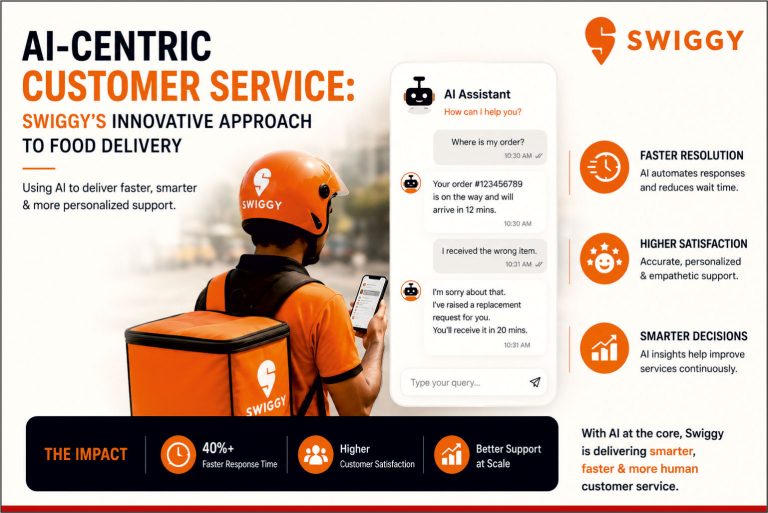
India is not one market. AI enables consumer research at the pin-code level that was cost-prohibitive before. Swiggy uses demand data to price menus and set delivery radii street by street. BCG’s 2025 India report specifically identifies inclusive, last-mile AI adoption as a defining competitive opportunity for Indian businesses [5].
3. From periodic to continuous.
Traditional market research was an annual event. AI-assisted research is a live feed. As per HBR’s 2025 analysis, generative AI enables firms to fill gaps in market understanding by generating insights not available in conventional data, including creating new data types through digital twins [1].
AI is also reshaping management itself
Beyond market research, AI is restructuring how organizations are managed. McKinsey’s 2025 State of AI report found that 88% of companies now use AI in at least one business function, yet only one-third have begun scaling programs enterprise-wide [3]. The biggest barrier to success is not technology but leadership: organizations fail at AI not because they cannot build the tools but because leaders do not know how to embed them into how decisions are actually made [4].
BCG’s survey of 1,400+ C-suite executives found that three-quarters name AI as a top-three strategic priority for 2025, and that leading companies allocate over 80% of their AI investments to reshaping key functions and inventing new offerings, not just smaller productivity tweaks.[8]
The MIT SMR and TCS 2025 joint study introduced the concept of ‘Intelligent Choice Architectures’: AI systems that do not merely advise human decision-makers but actively generate new strategic options, learn from outcomes, and reshape the available decision landscape. The shift they describe is from AI as an adviser to AI as an architect [9].
What this means for your MBA: 7 Practical things to do this week
Here is the actionable section. Not ‘understand AI broadly.’ Specific actions, specific tools, specific outcomes you can produce before your next semester.
Run a real consumer insight project using free tools. Pick a brand you find interesting. Use Google Trends, Glimpse (free tier), and a tool like Brandwatch or Sprinklr to map what Indian consumers are saying about it. Write a one-page insight memo before your next marketing class. You will walk in knowing more than the case study does.
Learn enough Python to be useful, not an expert. Run a basic sentiment analysis on an Amazon India or Flipkart product review dataset. Kaggle’s free Python intro course gives you the foundation in roughly 20 focused hours. The goal is not to become a data scientist but to be able to brief one intelligently.
Interview a small business owner about their technology use. Find a local retailer, salon, or logistics franchise, someone running a five-to-twenty-person business. Ask what digital tools they use, what problems remain unsolved, and what they wish existed. This is more valuable market research training than any textbook case study, and you may find your first startup idea.
Build a personal ‘AI clipping file.’ Every week, read one article from Harvard Business Review (HBR), one from McKinsey Quarterly, and one from an Indian source such as The Ken, Inc42, or FactorDaily. Summarise each in three sentences. After three months, you will have a mental model of AI in business that most working managers simply do not possess.
Use AI to create a visible win during your internship. During your summer internship, identify one manual, repetitive task your team performs regularly. Build a simple AI-assisted workflow to automate or accelerate it. Document the time saved. That is a concrete, verifiable achievement you can describe in every job interview for the next three years.
Practice the ethics argument, you will need it in every room. BCG’s research shows organizations deploying AI without ethical guardrails face serious reputational and regulatory risk.[8] Be the person in the room who asks, ‘Who is this model trained on?’ and ‘What happens when it is wrong?’ The combination of technical fluency and ethical clarity is rare and consequently very valuable.
Follow the Indian AI ecosystem, not just the American one. Subscribe to iSpirt, Sequoia India’s Surge, and the NASSCOM AI portal. The tools being built for Indian languages, Indian supply chains, and India’s informal economy are world-class. Knowing this landscape is a genuine competitive edge in any India-focused business interview or role.
“The best way to predict the future is to create it. AI gives young managers the tools to do exactly that, if they choose to pick them up.”
Satya Nadella, CEO, Microsoft, paraphrasing the central argument of Hit Refresh (HarperCollins, 2017)
The Conclusion…..
The biggest mistake you can make is to wait for your organization to teach you AI. Organizations are slow. Markets are fast. The students who will lead Indian business in 2035 are the ones building AI literacy in 2026, not because they were told to, but because they were curious enough to start.
The DeHaat team, the Nykaa data team, and the Lenskart store-expansion engine all share one characteristic: they identified a specific problem, applied a specific tool, measured the result, and scaled what worked. That orientation, problem first, then tool, then measurement, is the actual skill that AI rewards. Go build something…
References and Bibliography
[1] Korst, J., Puntoni, S. & Toubia, O. (2025). How Gen AI Is Transforming Market Research. Harvard Business Review. https://hbr.org/2025/05/how-gen-ai-is-transforming-market-research
[2] Brand, J., Israeli, A. & Ngwe, D. (2025). Using Gen AI for Early-Stage Market Research. Harvard Business Review. https://hbr.org/2025/07/using-gen-ai-for-early-stage-market-research
[3] McKinsey QuantumBlack (2025). The State of AI 2025: Agents, Innovation, and Transformation. McKinsey & Company. https://www.mckinsey.com/capabilities/quantumblack/our-insights/the-state-of-ai
[4] McKinsey & Company (2025). Superagency in the Workplace: Empowering People to Unlock AI’s Full Potential. McKinsey & Company. https://www.mckinsey.com/capabilities/tech-and-ai/our-insights/superagency-in-the-workplace-empowering-people-to-unlock-ais-full-potential-at-work
[5] BCG India (2025). India’s Triple AI Imperative: Transforming Businesses at Scale. Boston Consulting Group. https://www.bcg.com/publications/2025/india-triple-ai-imperative
[6] BCG & Google India (2025). Unlocking AI’s Potential in India: Transforming Agriculture and Healthcare. Boston Consulting Group. https://www.bcg.com/publications/2025/india-unlocking-ai-potential-in-india-transforming-agriculture-and-healthcare
[7] BCG & IIM Ahmedabad (Brij Disa Centre) (2023). AI in India: A Strategic Necessity. Boston Consulting Group. https://web-assets.bcg.com/13/72/6376db51419389790f2cffa12489/ai-in-india-a-strategic-necessity.pdf
[8] BCG (2025). From Potential to Profit: Closing the AI Impact Gap. Boston Consulting Group. https://www.bcg.com/publications/2025/closing-the-ai-impact-gap
[9] MIT Sloan Management Review & TCS (2025). MIT SMR and TCS Study Reveals the Changing Role of AI in Decision-Making. PR Newswire / MIT SMR. https://www.prnewswire.com/news-releases/mit-sloan-management-review-and-tcs-study-reveals-the-changing-role-of-ai-in-decision-making-302504550.html
[10] MIT Sloan Management Review (2026). Calibrate AI Use to the Decision at Hand. MIT Sloan Management Review. https://sloanreview.mit.edu/article/calibrate-ai-use-to-the-decision-at-hand/
[11] NASSCOM / Green Agrevolution Pvt. Ltd. (n.d.). Agritech Case Study Series: DeHaat. NASSCOM Community. https://community.nasscom.in/communities/digital-transformation/agritech/agritech-case-study-series-dehaat.html
[12] Kumar, S. (CEO, DeHaat) (2020). Agritech Start-Up DeHaat Helps Farmers Grow and Earn Better. Entrepreneur India. https://www.entrepreneur.com/en-in/technology/agritech-start-up-dehaat-helps-farmers-grow-and-earn-better/351089
[13] NITI Aayog Frontier Tech Repository (2025). DeHaat’s AI-Enabled Agriculture Network Driving Market Access and Efficiency for 1.8 Million Farmers. Government of India / NITI Aayog. https://frontiertech.niti.gov.in/story/dehaats-ai-enabled-agriculture-network-driving-market-access-and-efficiency-for-1-8-million-farmers/
[14] Nykaa / Amazon Web Services (2024). Nykaa Case Study: Scalable Data Lake on AWS. Amazon Web Services. https://aws.amazon.com/solutions/case-studies/nykaa/
[15] Nykaa Financial Results (FSN E-Commerce Ventures) (2024). Nykaa Q2 FY25 Results: Net Profit Doubled, Revenue Up 27% YoY. BIBS / Nykaa Investor Relations. https://www.bibs.co.in/blog/how-nykaa-built-a-data-driven-marketing-engine-an-mba-case-study
[16] Whalesbook Financial Research (2026). Lenskart’s AI Engine Fuels Growth. Whalesbook. https://www.whalesbook.com/news/English/consumer-products/Lenskarts-AI-Engine-Fuels-Growth-But-Valuation-Scrutiny-Mounts/69929bbf2e6a0b8ae17c8faa
[17] The D2C Pulse (2026). The Lenskart Omnichannel Strategy: A Case Study. The D2C Pulse. https://thed2cpulse.com/case-studies/lenskart-omnichannel-strategy-case-study/
[18] Puri, A. (Partner, McKinsey India) in Outlook Business (2025). How India Is Faring in AI: From a McKinsey Partner’s Vantage Point. Outlook Business. https://www.outlookbusiness.com/start-up/news/how-india-is-faring-in-ai-from-a-mckinsey-partners-vantage-point-2
Written by
Dr. Piyush Pachauri is a biotechnologist and computational scientist at ICGEB New Delhi, working at the intersection of experimental microbiology and computational biology. He builds genome-scale metabolic models of Streptomyces using the COBRA Toolbox and FSEOF in MATLAB to engineer higher yields of pristinamycin, a clinically valuable antibiotic. His work integrates proteomics, flux analysis, and data visualisation to guide wet-lab strategies against antimicrobial resistance. Beyond the lab, he is a keen science communicator and advocate for biotech entrepreneurship in India.