Discover what an AI-centric PGDM program is,
HOW it differs from a traditional MBA,
WHO should pursue it, and
WHY it’s the future of management education in India.
A late 2025 study by ICRIER, supported by OpenAI, revealed a defining shift in the Indian corporate landscape: 63% of companies now actively demand ‘hybrid’ professionals—individuals who pair deep domain expertise with practical AI skills.
This requirement aligns with global benchmarks where India ranks #1 in AI skill penetration, and 49% of Indian enterprises already classify themselves as ‘mature AI adopters’.
Read those numbers together, and a clear picture emerges: the Indian job market is no longer asking if business managers should know AI. It is demanding to know how effectively they can deploy it. Yet, the vast majority of traditional management degrees still treat AI as nothing more than an optional elective.
This gap is exactly what the AI-centric PGDM is built to close.
If you are a student, parent, or working professional trying to understand what an AI-centric PGDM actually is, how it differs from a traditional MBA, and whether it is worth pursuing in 2026, this guide will answer every question you have.
What you’ll learn through this guide
By the end of this blog, you will understand:
1. What an AI-centric PGDM program is and how it works?
2. Why this format emerged in Indian management education?
3. How it differs from a traditional MBA or PGDM?
4. What subjects, tools, and skills you will study?
5. Whether this program is the right fit for your background?
6. What career paths and salary outcomes to expect?
7. How to evaluate AI-centric PGDM programs offered in India?
Choosing a two-year management program is a major career milestone. This guide offers a comprehensive breakdown to help you make an informed decision. We have included links to detailed resources throughout, so feel free to jump straight to the sections that matter most to you.
What Is an AI-centric PGDM Program?
A PGDM is a two-year, full-time management qualification offered by autonomous institutions approved by the AICTE. The primary difference lies in governance: an MBA is awarded by a university, whereas a PGDM is an autonomous diploma granted by the institute itself. This flexibility allows a PGDM program to update its curriculum rapidly to match industry shifts. Conversely, rigid university approval cycles often take years, leaving traditional MBA syllabi struggling to reflect the fast-paced realities of modern management in India.
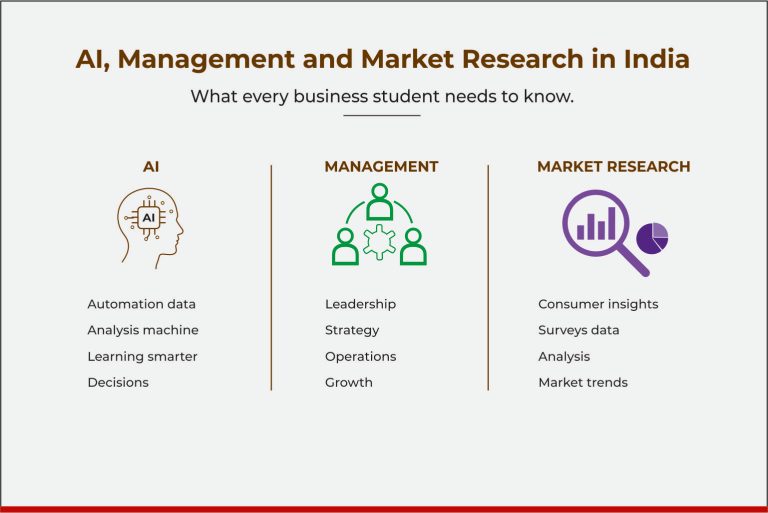
An AI-centric PGDM takes this flexibility one step further. Instead of treating AI and Data Science as separate electives, it weaves AI tools, frameworks, and decision-making into every functional area of the curriculum.
In simple terms:
A traditional PGDM teaches you how to manage a business.
An AI-centric PGDM teaches you how to manage a business in an AI-driven world.
The three defining features of an AI-centric PGDM:
Integration, not addition – AI is not a single subject taught in one semester. It is integrated across every functional course. You will learn marketing alongside AI-powered customer analytics. You will study finance alongside algorithmic decision making.
Tool fluency over theory alone – Students develop working familiarity with AI tools used in industry, ChatGPT, Claude, Gemini, Power BI, Tableau, predictive modelling platforms, and Generative AI applications for business.
Future-relevant specializations – Specializations are designed around the skills industries need in 2026 and beyond, typically Marketing, Finance, and AI and Data Sciences rather than legacy options.
The goal is of an AI centric PGDM is to never compromise the traditional knowledge that is necessary for management education, rather complement it with AI in order to enable students to thrive in an AI driven world. The result is a graduate who can step into a corporate role and immediately contribute to AI-enabled decisions, instead of needing 12–18 months of additional training to catch up.
Why AI-centric PGDM Programs emerged in India?
The shift did not happen overnight. Three forces converged between 2022 and 2026 to make AI-centric management education essential rather than optional.
The enterprise shift in India:
The data speaks for itself. A joint 2026 report by Zinnov, Z47, and OpenAI reveals that 49% of Indian companies are already mature AI adopters, while another 46% are rapidly scaling their early pilots. Because a mere 5% have yet to begin, AI is no longer a future prospect—it is the baseline reality. For any PGDM graduate entering the workforce, working alongside or managing AI systems is practically guaranteed.
The hiring market caught up:
The same ICRIER study cited earlier found that occupations most exposed to GenAI, including software development, marketing, finance, and operations are also showing the strongest demand growth. Roles like AI product manager, AI marketing lead, Data strategist, and AI compliance officer didn’t exist five years ago. In 2026, they are among the fastest growing job titles in India.
Employers no longer want managers who can ‘interpret reports prepared by analysts.’ They want managers who can ask the analyst the right questions, validate the AI’s reasoning, and translate output into business action.
Traditional MBAs began showing their age:
The case-study-heavy MBA model built in the US in the 1950s was designed for an era when data was scarce, decisions were slow, and frameworks like SWOT or Porter’s Five Forces could be applied across a quarter. In 2026, decisions are real-time, data is overwhelming, and AI systems handle the analytical layer that managers used to deliver themselves.
A 2026 World Economic Forum report estimates that 70% of the skills used in most jobs will change by 2030. A management graduate who finishes a 2-year program in 2028 needs to be ready for a 2030 workplace not a 2020 one.
This is why AI-centric PGDM programs exist. They are the response to a market that moved while traditional MBA curricula were still being revised.
AI-centric PGDM vs Traditional MBA: Differences that matter
Take a practical example:
Take a course like Marketing Management. In a traditional MBA, you would study the 4 Ps, segmentation theory, brand positioning, and a few Harvard cases. In an AI-centric PGDM, you study all of the above plus hands-on work with AI tools that perform customer segmentation, sentiment analysis from social media, predictive churn modelling, and AI-driven campaign optimization. You finish the course not just understanding marketing theory, but capable of running an AI-augmented marketing function on day 1.
The Bottom Line…..
The Indian management education landscape is splitting into two tracks. One track continues teaching the management of yesterday, useful, but increasingly insufficient for a market where 49% of enterprises are already mature AI-adopters. The other track AI-centric PGDM programs are building managers prepared to lead the businesses these enterprises are becoming.
If you are choosing a 2-year management commitment in 2026, the question is no longer PGDM or MBA? The question is: Will the curriculum I am paying for be relevant by the time I graduate? An AI-centric PGDM is not the only answer. But for students entering a workforce where 63% of Indian companies now actively seek hybrid skill sets, it is the most aligned answer.