
Offline
Building LLM Applications with Prompt Engineering
Duration
10 Hours
Level
Intermediate
Delivery
On Campus
Certificate
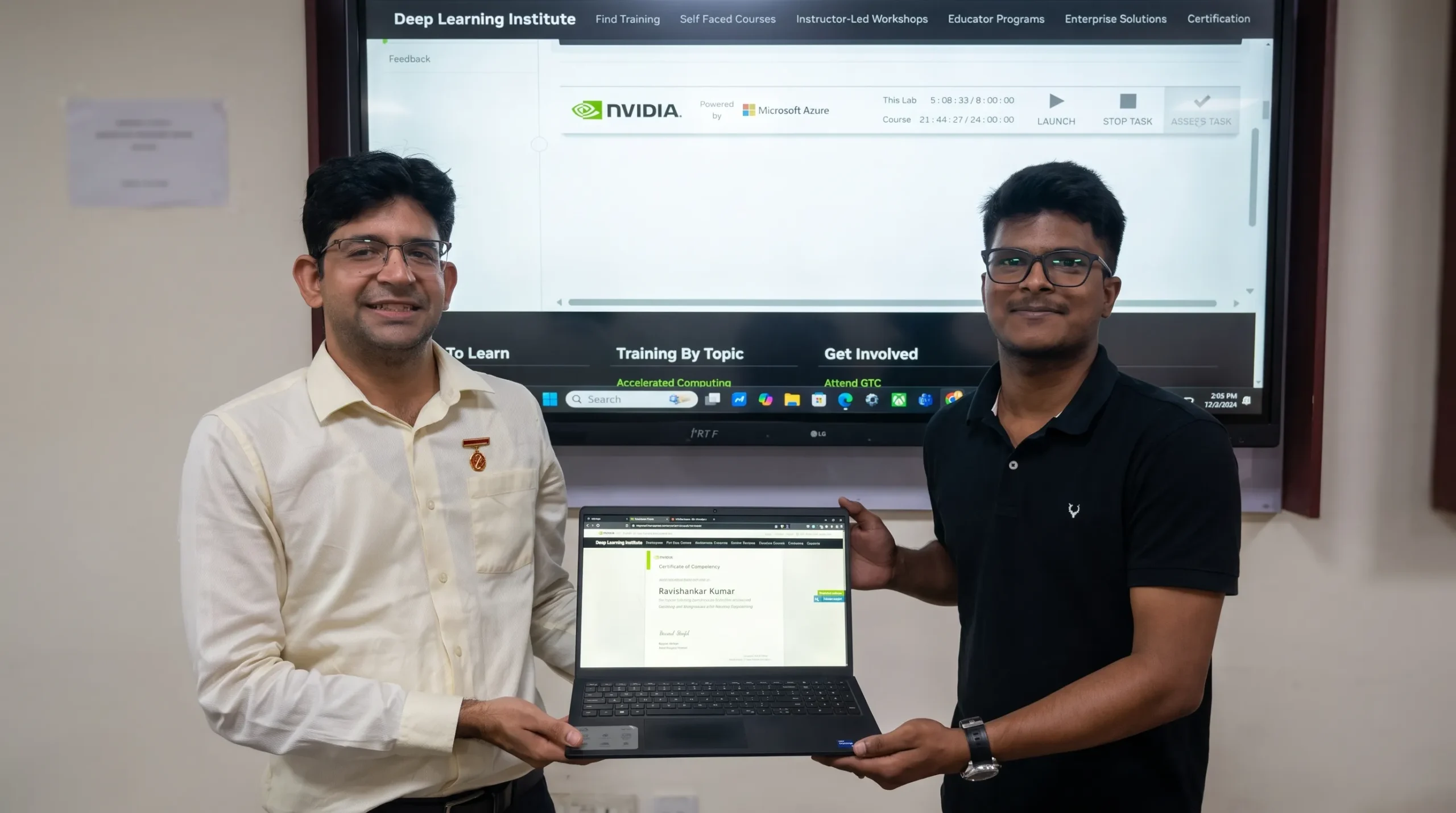
NVIDIA DLI Certificate
Start Date
28th September
Overview
Large language models are transforming how organisations build products, analyse documents, and interact with customers. But working with them effectively takes more than writing a good prompt; it requires a structured, engineering-first approach.
This hands-on workshop, delivered under the NVIDIA Deep Learning Institute framework, takes you from foundational prompt engineering principles through to building autonomous LLM agents. You will work directly with NVIDIA NIM powered by the open-source Llama 3.1 model, alongside LangChain, the industry standard framework for composing LLM workflows.
Every participant works in a fully configured, GPU-accelerated cloud environment provided by NVIDIA. No local GPU or setup is required, just a laptop and an internet connection.
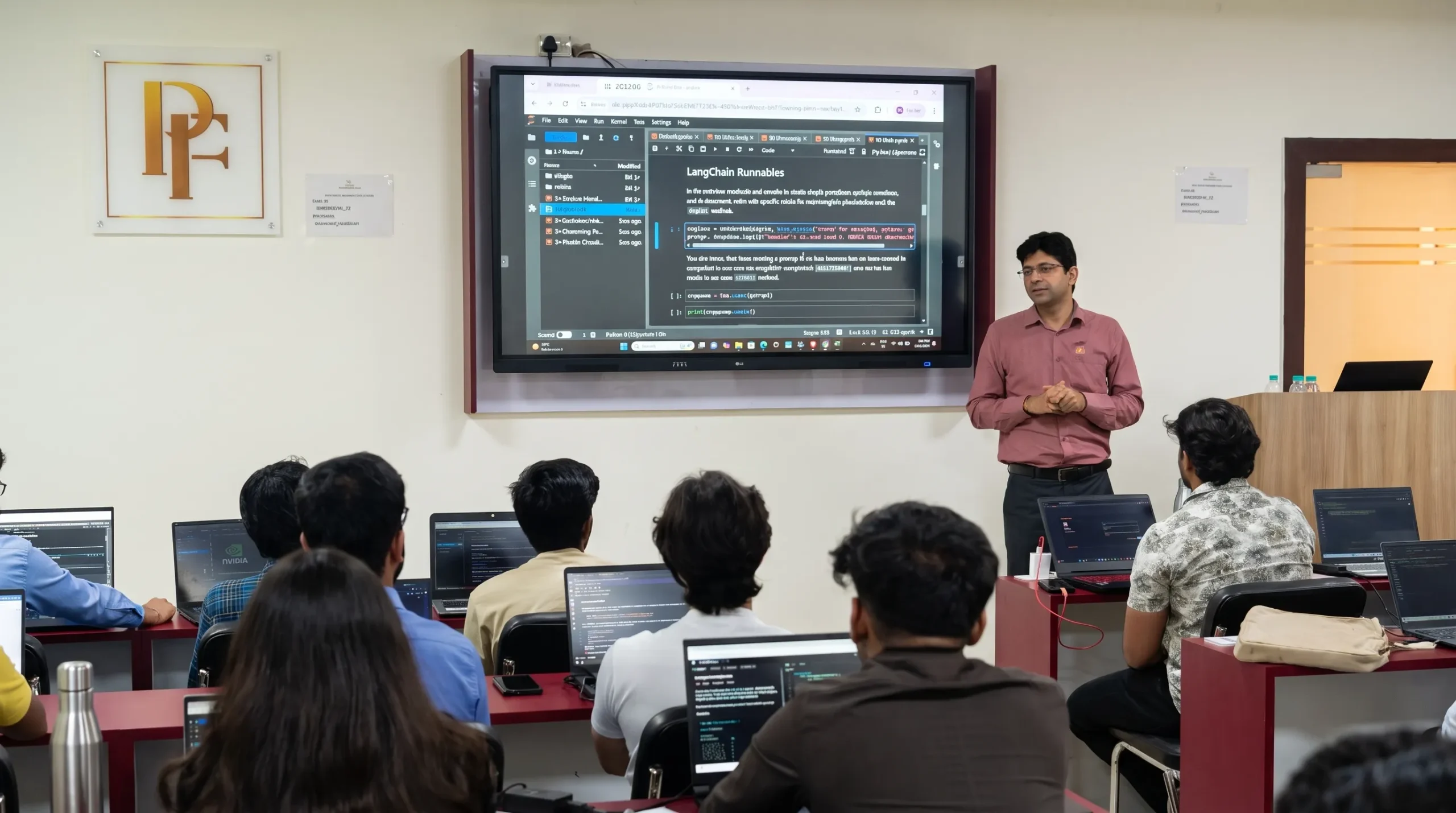
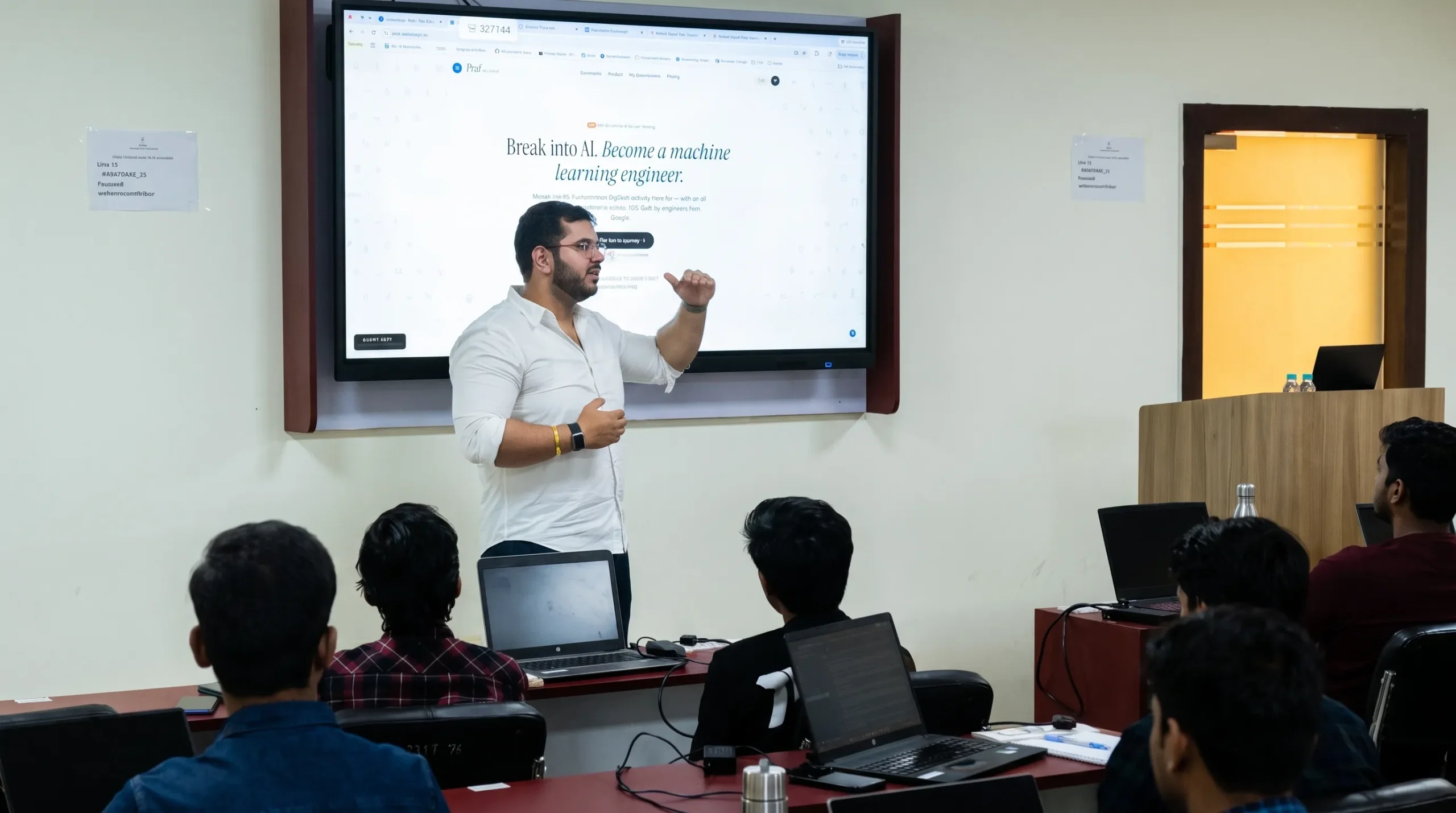
The workshop is led by an NVIDIA DLI Certified Instructor and is structured around live coding, mini-projects after each module, and a final assessment. By the end, you will have built your own working LLM application and earned a credential that demonstrates practical, verified capability.
What you will learn
- Apply iterative prompt engineering best practices to build LLM-powered applications for a wide range of language tasks
- Use LangChain Expression Language (LCEL) to compose runnables into chains, including parallel execution for performance
- Write custom Python functions and convert them into LangChain runnables
- Build chatbot applications with conversation history, persona management, and role definition through system messages
- Apply few-shot prompting and chain-of-thought techniques to improve reasoning on complex tasks
- Generate reliable structured output from unstructured text using Pydantic classes and LangChain’s JsonOutputParser
- Perform data extraction and document tagging at scale
- Create LLM-callable tools and build agents capable of reasoning about when tool use is appropriate
- Integrate real-time external API data into agent responses
- Deploy and interact with Llama 3.1 using NVIDIA NIM
Curriculum
Module 1: Course Introduction
Topics covered:
- Orientation to workshop topics, schedule, and prerequisites
- Why prompt engineering is core to interacting with large language models
- How prompt engineering underpins many classes of LLM-based applications
- Introduction to NVIDIA NIM and how it is used to deploy the Llama 3.1 model
- Familiarisation with the JupyterLab workshop environment and lab navigation
Outcome: Participants understand the scope of the workshop, the tooling stack, and can navigate the cloud lab environment independently.
Module 2: Introduction to Prompting
Topics covered:
- Creating and viewing responses from your first prompts using the OpenAI API and LangChain
- Streaming LLM responses in real time
- Sending prompts to LLMs in batches, and comparing performance differences between single, streamed, and batched calls
- The practice of iterative prompt development: writing, testing, refining
- Creating and using prompt templates for reusability
Mini project: Perform a combination of analysis and generative tasks on a batch of inputs.
Outcome: Participants can write, run, stream, and batch prompts programmatically, and understand how to iteratively improve prompt quality.
Module 3: LangChain Expression Language (LCEL), Runnables, and Chains
Topics covered:
- Understanding LangChain runnables as the core composable unit
- Composing runnables into chains using LangChain Expression Language (LCEL)
- Writing custom Python functions and converting them into runnables for inclusion in chains
- Composing multiple LCEL chains into a single larger application chain
- Identifying opportunities for parallel work and composing parallel LCEL chains for performance gains
Mini project: Perform analysis and generative tasks on a batch of inputs using LCEL and parallel execution.
Outcome: Participants can architect multi-step LLM workflows as composable chains rather than sequential one-off calls, and optimise them through parallelism.
Module 4: Prompting With Messages
Topics covered:
- The two core chat message types, human and AI messages, and how to use them explicitly in application code
- Few-shot prompting: providing chat models with instructive examples to guide output
- Working with the system message to define an overarching persona and role for chat models
- Chain-of-thought prompting to improve model performance on tasks requiring complex reasoning
- Managing message history to retain conversation context and enable chatbot functionality
Mini project: Build a simple yet flexible chatbot application capable of assuming a variety of roles.
Outcome: Participants can build stateful, persona-driven conversational applications and apply reasoning-enhancement techniques.
Module 5: Structured Output
Topics covered:
- Basic methods for using LLMs to generate structured data in batch for downstream use
- Generating structured output through a combination of Pydantic classes and LangChain’s
JsonOutputParser - Extracting data and tagging it to a specified schema out of long-form text
Mini project: Use structured data generation techniques to perform data extraction and document tagging on an unstructured text document.
Outcome: Participants can reliably convert freeform LLM output into typed, validated data structures that downstream code can consume without parsing errors.
Module 6: Tool Use and Agents
Topics covered:
- Creating LLM-external functionality called tools, and making the LLM aware of their availability
- Building an agent capable of reasoning about when tool use is appropriate
- Integrating the result of tool use back into the agent’s responses
Mini project: Create an LLM agent capable of utilising external API calls to augment its responses with real-time data.
Outcome: Participants can build agents that extend beyond the model’s training data by calling external functions and APIs autonomously.
Module 7: Assessment and Final Review
Topics covered:
- Review of key learnings across all modules and open Q&A
- Completion of the skills-based coding assessment
- Workshop survey
- Recommendations for next steps in the learning journey
Outcome: Participants who pass the assessment earn the NVIDIA DLI Certificate of Competency.
Prerequisites
Technical background required:
- Working knowledge of Python 3, including functions, loops, dictionaries, and control flow
- Familiarity with installing and using Python libraries and packages
- Comfort with reading and writing code in a Jupyter notebook environment
Recommended but not mandatory:
- Basic familiarity with LLM concepts (what a model is, what a prompt does)
- Prior exposure to APIs and making requests in Python
Deep machine learning expertise is not required. This workshop is designed for intermediate Python developers, not ML researchers.
What you need to bring:
- A laptop or desktop capable of running the latest version of Google Chrome or Mozilla Firefox
- No GPU required; NVIDIA provides a fully configured, GPU-accelerated cloud workstation for every participant
Certificate
Start Now
Fee: ₹2,499
Seats Available: 40 only
Seats for each session are strictly capped at 40 participants to ensure a genuinely hands-on experience with individual attention from the instructor. Registrations are confirmed on a first come, first served basis.
Registration includes full access to the NVIDIA DLI cloud lab environment, all workshop materials, live instruction across both days, and eligibility for the NVIDIA DLI Certificate of Competency.
Duration: 10 Hours
Queries: +91 88600 05458
Register now to secure your seat.
Enquiry Form
Gallery
Students speak

Frequently Asked Questions
Find answers to common questions about the Building LLM Applications with Prompt Engineering course.
Building LLM Applications with Prompt Engineering is a hands-on intermediate programme focused on designing and building practical applications powered by large language models. The course combines prompt engineering, LangChain, NVIDIA NIM, Llama 3.1, structured outputs, tools and autonomous LLM agents.
This programme is designed for intermediate Python developers who want to move beyond basic prompting and learn how to engineer complete LLM-powered applications. Deep machine learning expertise is not required.
You will learn iterative prompt engineering, LangChain Expression Language (LCEL), runnables and chains, chatbot development, conversation history, few-shot prompting, structured output, data extraction, document tagging, tool use, external API integration and LLM agents.
Participants should have working knowledge of Python 3, including functions, loops, dictionaries and control flow. Familiarity with installing Python libraries and working in a Jupyter Notebook environment is also expected. Basic familiarity with LLMs and APIs is useful but not mandatory.
The programme works with Python, LangChain, LangChain Expression Language (LCEL), JupyterLab, Pydantic, JsonOutputParser, NVIDIA NIM and Llama 3.1. Learners also work with APIs and techniques for building tool-enabled LLM agents.
Yes. You learn how to build stateful chatbot applications with conversation history, personas and system messages. The course also covers creating LLM-callable tools and building agents that can decide when to use external functions and APIs.
No local GPU is required. NVIDIA provides a fully configured GPU-accelerated cloud workstation for each participant. You only need a laptop or desktop capable of running a current version of Google Chrome or Mozilla Firefox.
The course is hands-on and structured around live coding, practical exercises and mini-projects. Learners build prompt workflows, LCEL chains, chatbot applications, structured data pipelines and an LLM agent that can work with external APIs.
The programme has a total duration of 10 hours and is delivered on campus. The training combines instructor-led learning, live coding, practical exercises, mini-projects and a final skills-based assessment.
Participants who successfully pass the final skills-based coding assessment receive an NVIDIA DLI Certificate of Competency issued directly by NVIDIA. The assessment requires working code and demonstrates practical capability rather than attendance alone.