
Offline
Claude101: The Modern AI Stack
Duration
~30 Hours
Level
Beginner
Delivery
On Campus
Certificate
PRTF × CloudThat
Start Date
28th September
Overview
Everyone in your batch has a generative AI certificate. Almost none of them have shipped an agent.
There is a difference between having used an AI tool and having built one. The first is now assumed on every fresher CV. The second is still rare enough to be worth interviewing for.
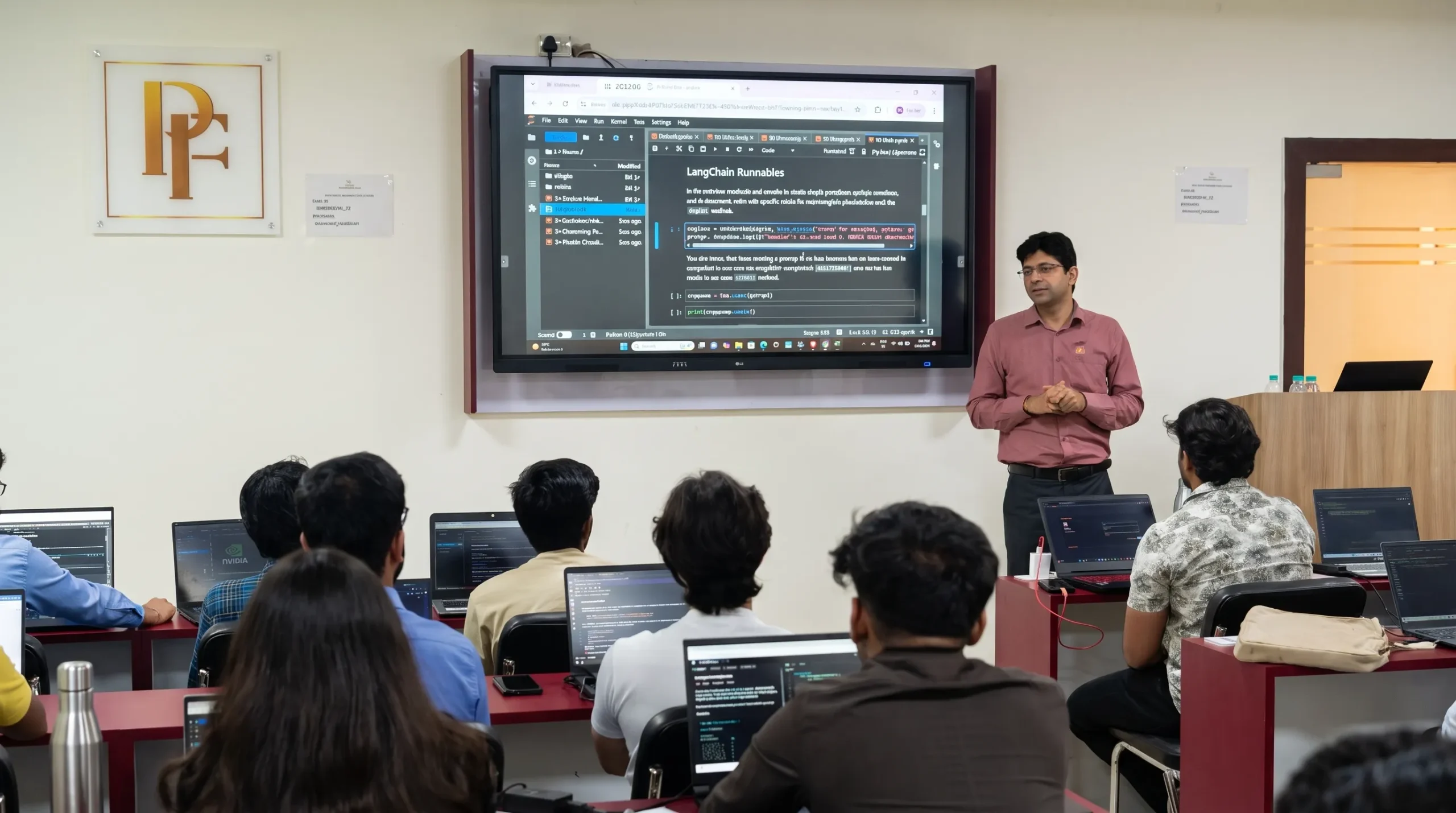
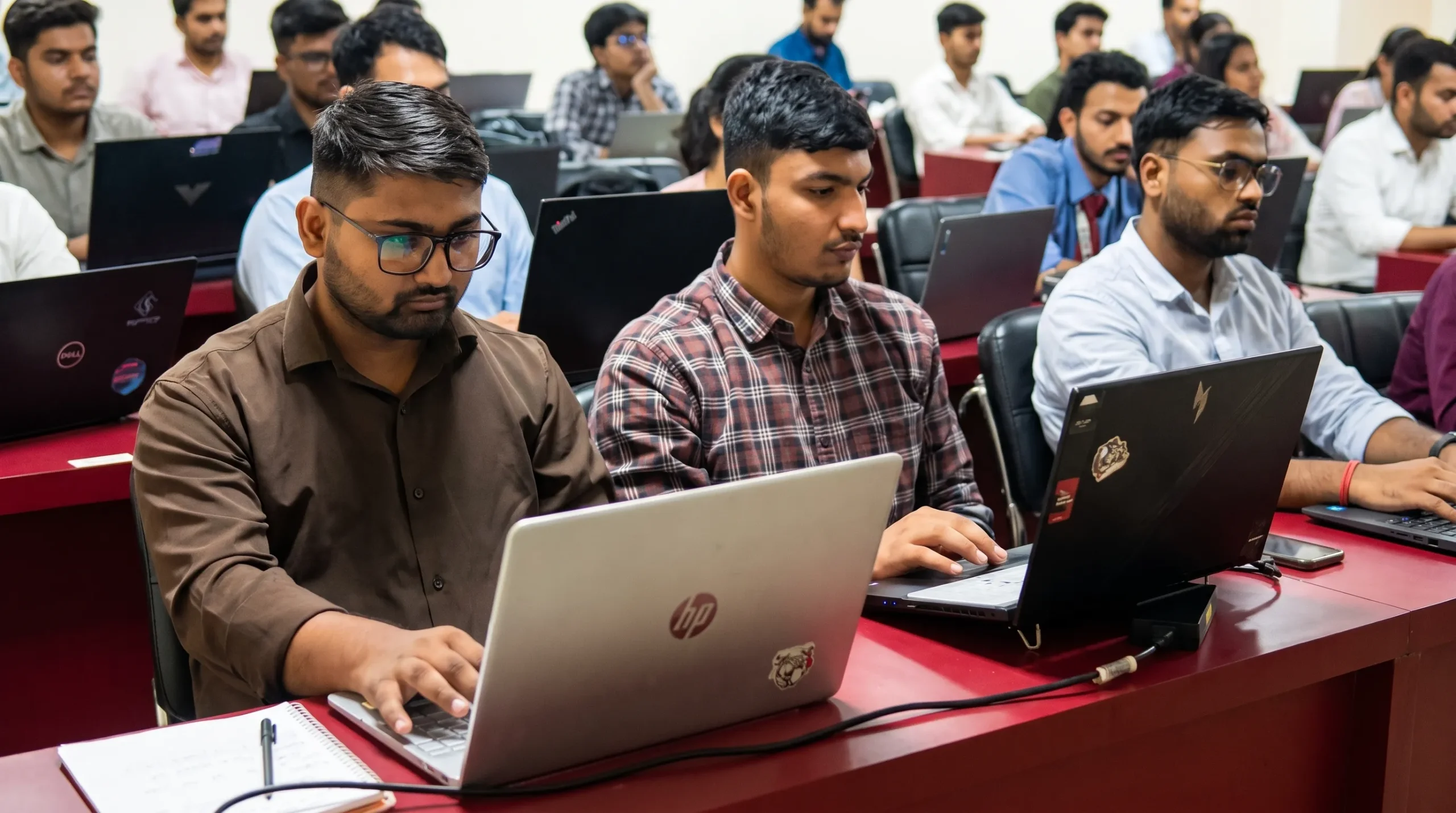
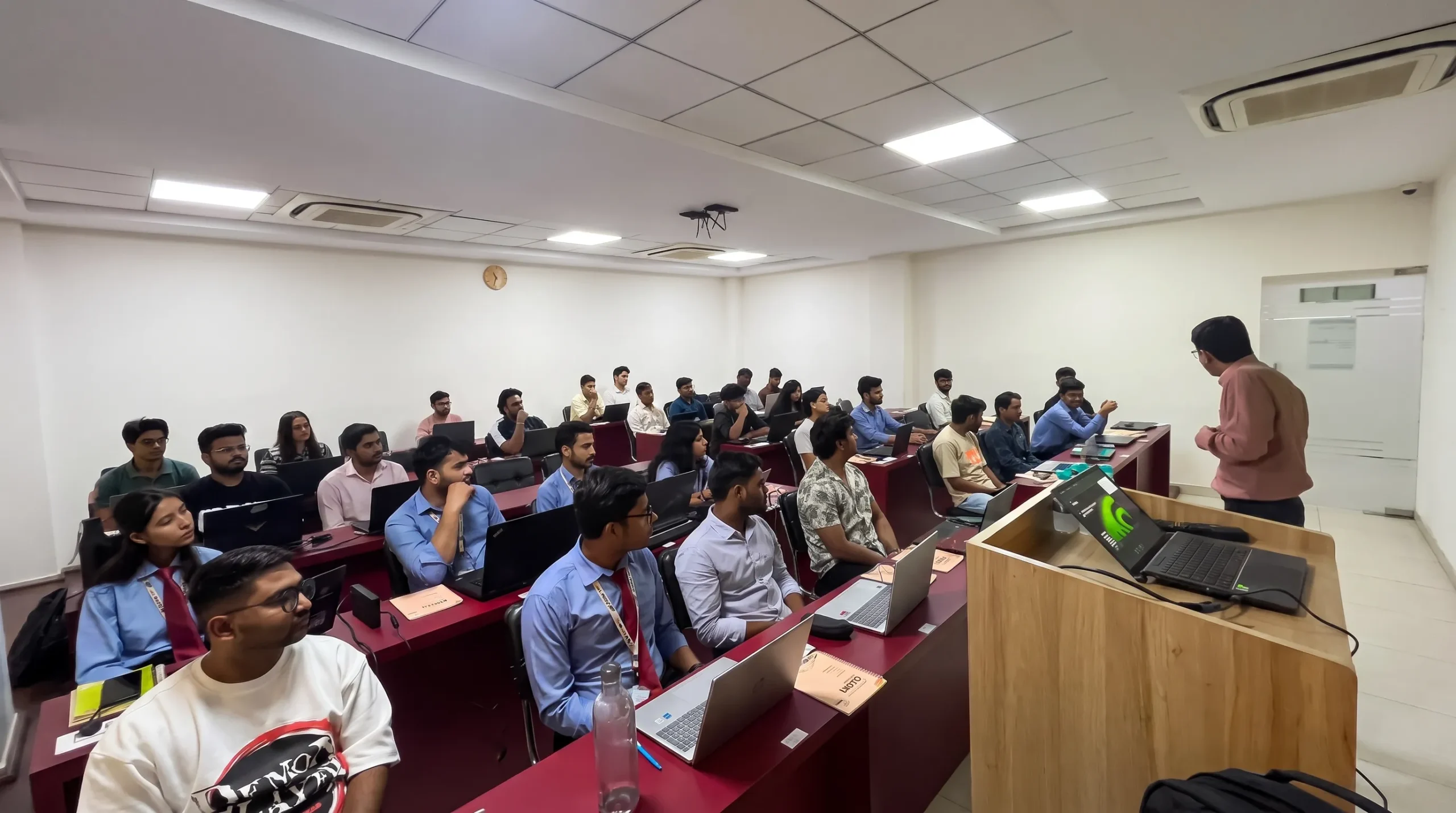
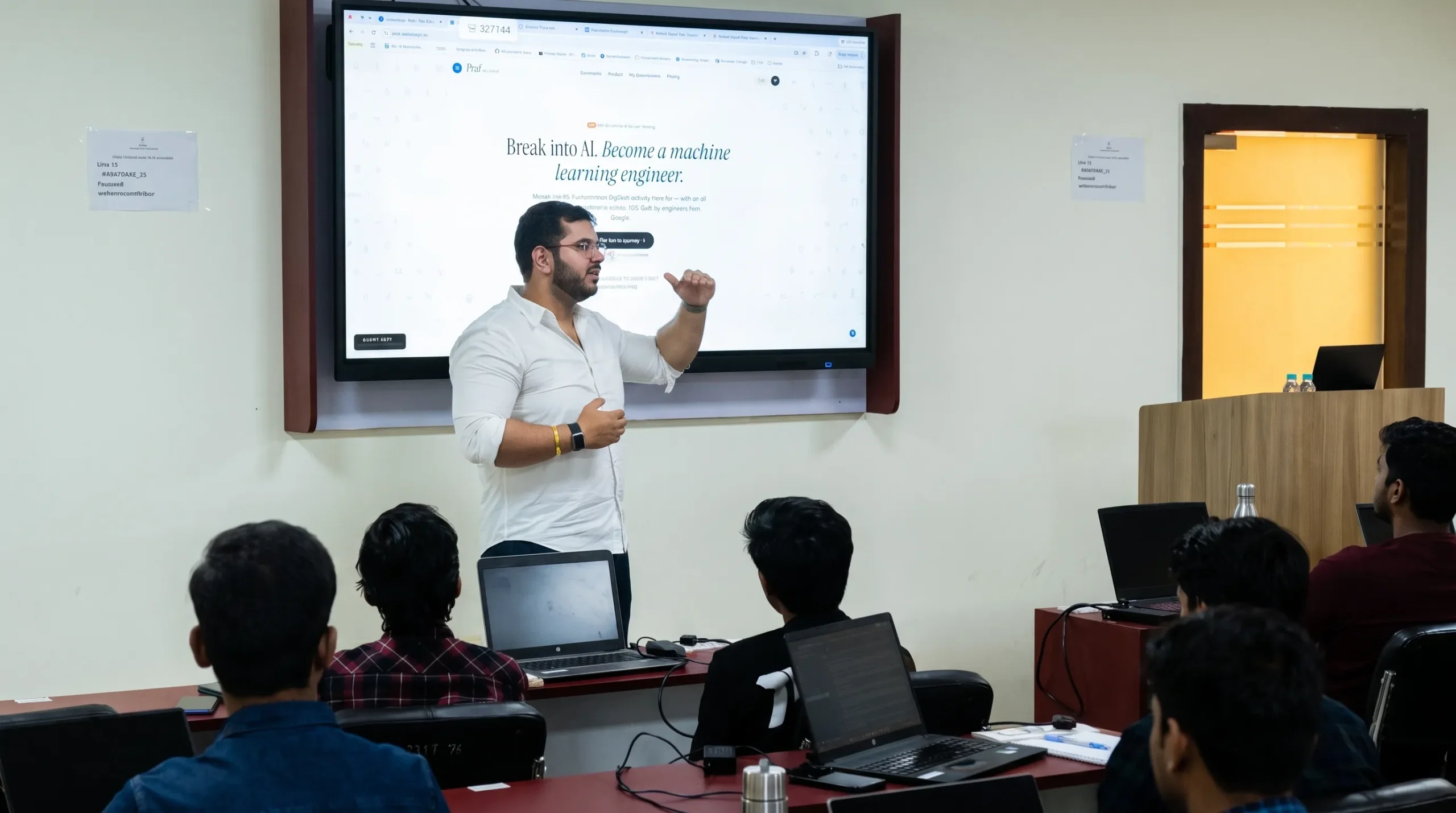
Claude 101 is an, in-person program at the PRTF campus in Greater Noida, delivered in partnership with CloudThat. Around 30+ hours you write the retrieval pipeline, the tool calls, the evaluation harness and the agent loop yourself. You do not watch someone else build them. At the end of the week you leave with five working systems on your own laptop and the ability to explain every line of them.
The program is built around Claude and the Anthropic API, which is not an arbitrary choice. As of May 2026, Anthropic held roughly 40% of enterprise spending on large language models and roughly 54% of the AI coding assistant market, with around 70% of the Fortune 100 as customers. You are not learning a chatbot. You are learning the system enterprises are actually buying, using the same protocols, patterns and tooling that production teams use.
What you will learn
Five days, five systems. Each one is a thing that runs, not a thing you have heard of.
1. A multi-tool assistant You define tool schemas, handle tool-call message blocks, return results to the model, and run a multi-turn tool conversation. By the end of the session the assistant decides for itself which tool to reach for.
2. A retrieval pipeline over a real document corpus You chunk a PDF corpus, embed it, run vector search against BM25 lexical search, then combine both into hybrid retrieval and measure which answers improve. This is the single most requested capability in Indian AI job postings, and most candidates have only read about it.
3. An evaluation harness You generate a test set, run responses against it, and grade them with a second model call and with code. Anyone can produce an output. Being able to prove an output is good is what separates a demo from a system.
4. An MCP server and its client You build a Model Context Protocol server that exposes a filesystem tool and a data resource, inspect it, then write the Python client that calls it. This is the protocol the industry standardised on for connecting models to real systems.
5. An end-to-end agentic system The capstone. Retrieval, tools and MCP combined into one agent that researches, decides and reports, then presented to the room for review.
The full stack, in one place
Everything below is taught with your hands on the keyboard, not on a slide.
Foundations — tokens · context windows · system prompts · temperature · top-p and top-k · streaming vs batch
Prompt craft — XML-structured prompts · few-shot and zero-shot · chain of thought · negative examples and constraints · structured JSON output · anti-patterns
Retrieval — chunking strategies · embeddings and vector search · BM25 · hybrid multi-index retrieval · contextual retrieval
Agents and tooling — tool schemas · multi-turn tool conversations · MCP servers · MCP clients · the inspector · chaining · routing · parallelisation · sub-agents · hooks · CLAUDE.md · Computer Use
Production — eval harnesses · model-graded and code-graded scoring · prompt caching · cost and rate-limit management · API key hygiene · audit logging
Curriculum
Foundations, and your first prompt written as an engineer
What is Claude, and what is Anthropic The model family and where each member fits: Haiku for speed and volume, Sonnet for balance, Opus for hard reasoning. How Claude differs from other large language models. Constitutional AI and what responsible deployment actually requires in practice. Where these models are already in production across industries.
How Claude works: the core concepts Large language model fundamentals without the mathematics. Tokens, and why they determine both your cost and your limits. Context windows and what happens at the edge of one. The role of the system prompt. Temperature and randomness, and when you want each. Streaming responses against batch responses, and when the difference matters to a user.
Claude Code: getting started What separates an AI coding agent from a chat interface. Installation across the terminal, VS Code, JetBrains and the desktop app. The agentic loop explained: how the model reads, decides, acts and checks. Tools and permissions. Approval mode, auto-accept and plan mode, and why plan mode is the one most professionals underuse. Lab: install Claude Code in VS Code, run your first prompt, work through plan mode on a real task.
AI fluency: the 4D framework Discover, discern, develop, deploy. How fluency differs from literacy, which is the gap between having used a tool and being able to direct one. Mapping model capability onto workflows you already have. Ethical use in professional settings, including disclosure.
Workshop Where can Claude add immediate value in the work you are already doing. Open question and answer on the day’s concepts. Mini-challenge: describe a real problem, then identify which model and which mode fits it best. Lab: hands-on exploration of Claude and Claude Code, working from your own problem rather than a sample one.
The API, prompt engineering, and how to prove your output is good
Accessing the Anthropic API The Anthropic Console, end to end. Obtaining API keys and managing them without leaking them. Making your first request in both curl and Python. Request structure: model, messages, max tokens. Formatting a multi-turn conversation correctly, which is where most first attempts quietly go wrong. Lab: obtain a key, make your first call, then build a working multi-turn chat loop in Python.
System prompts and model control Writing system prompts that hold under pressure. Role assignment and shaping a consistent persona. Temperature, top-p and top-k, and what each one actually changes. Streaming in practice. Getting structured JSON out reliably rather than hopefully. Lab: experiment with system prompts and temperature settings, then stream responses to your terminal.
Prompt engineering techniques Being clear and direct, and what specificity means concretely. Structuring prompts with XML tags. Few-shot and zero-shot prompting, and how to choose. Chain of thought and reasoning prompts. Negative examples and constraint setting, which is the technique most people never learn. The common anti-patterns, and why each one fails. Lab: take a vague prompt and iteratively improve it until it produces reliable structured output.
Prompt evaluation workflows Why evaluations matter the moment anything reaches a real user. What a typical eval workflow looks like. Generating a test dataset. Running evaluations automatically. Model-based grading against code-based grading, and when each is appropriate. Lab: build a simple eval harness. Generate test cases, run Claude against them, and grade the results with a second Claude call.
Workshop Combine a system prompt, prompt engineering and evaluation into one small project. Group review of everyone’s output. A best-practice checklist you keep. Lab: build and evaluate a small Claude-powered question and answer assistant.
Tool use, retrieval, and the features that make both cheaper
Tool use with Claude Function calling from first principles. Defining tool schemas the model can actually use. Handling tool-call message blocks. Sending results back and continuing the conversation. Multi-turn tool exchanges. Using several tools at once, and fine-grained tool calling. The built-in tools, including text editing and web search. Lab: implement a multi-tool assistant that handles both weather lookup and calculation, and decides for itself which to call.
Retrieval-augmented generation What retrieval is and why it exists. Chunking strategies, and how chunk boundaries silently determine answer quality. Text embeddings and vector search. BM25 lexical search, and the cases where it beats embeddings outright. Building a full pipeline. Multi-index hybrid retrieval that combines both. Contextual retrieval for accuracy. Lab: build a retrieval pipeline over a PDF corpus, then compare BM25 against embedding search on the same questions and measure which answers improve.
Advanced Claude features Extended thinking mode and when the extra reasoning pays for itself. Image analysis and multimodal input. PDF processing and document understanding. Citation generation for outputs that can be checked. Code execution and the Files API. Lab: upload a PDF, extract citations, and analyse an embedded chart using vision.
Prompt caching What caching is and when to reach for it. The rules and constraints that govern it. Implementing it to cut both latency and cost. Measuring your cache hit rate, because an unmeasured cache is a guess. Lab: configure caching on a long system prompt, then measure latency before and after.
Workshop Combine retrieval with tool-augmented responses. Group challenge: extend your retrieval assistant so it can also call an external API. Lab: an agentic retrieval assistant with live tool calling.
Model Context Protocol and Agentic AI
Introduction to MCP What the Model Context Protocol is and the problem it was created to solve. The architecture: servers, clients and hosts, and how the three relate. How MCP compares to wiring tools directly through the API. The current ecosystem and what is already available.
Building an MCP server Project setup and environment. Defining tools with MCP schemas. Using the server inspector to see what you have actually exposed. Defining resources and how clients reach them. Defining and exposing prompts through MCP. Lab: build an MCP server that exposes a filesystem tool and a custom data resource, then test it with the inspector.
Building an MCP client Implementing a client in Python. Connecting to servers. Invoking tools and reading resources through the client. A full end-to-end walkthrough of the flow, so the whole protocol stops being abstract. Lab: connect your client to the server you built, then run a multi-step tool workflow across both.
Agents and agentic workflows What actually distinguishes an agent from a chatbot. Parallelisation: fanning out and aggregating. Chaining: sequential multi-step pipelines. Routing: dispatching by intent. Agents with tools, and environment inspection. The judgement call that matters most in production: when a fixed workflow is the right answer and when you need a full agent. Lab: build a chaining workflow that researches a topic, summarises what it finds, and drafts a report.
Workshop Design and prototype a multi-step agent combining MCP, tool use and retrieval. Group architecture review, where every design gets questioned by the room. Lab: each team presents its agent design and takes peer feedback.
Prerequisites
Four things, and you are ready.
- You can write a Python function and read an error message without panicking.
- You have used ChatGPT or Claude, but you have never called an API.
- You have a laptop you are allowed to install software on.
- You want proof of what you can do, not vocabulary to describe it.
Not required: machine learning theory · a GPU · prior cloud experience · a computer science degree · prior experience with agents or retrieval
If you are in your second year and you can already write Python, the year does not matter. If you cannot yet write a Python function, this is the wrong program to start with, and we would rather tell you now than take your registration.
What to bring: a laptop with at least 8 GB RAM, admin rights to install software.
Certificate
Start Now
Fee: ₹11,999
Around 30+ hours of live instruction.
Included
- 30+ hours in person at the PRTF campus, Greater Noida
- All five build sessions, with your own laptop on the desk
- The complete codebase you write, yours to keep and extend
- Co-branded PRTF × CloudThat certificate
Batch details
- Dates: Starting 24th August
- Seats: 50. The cohort is capped so that every participant gets time at the keyboard with an instructor in the room.
Questions: +91 8586939002 or contact@pathfinderfoundation.co.in
Enquiry Form
Gallery
Students speak

Frequently Asked Questions
Find answers to common questions about the Claude101: The Modern AI Stack programme.
Claude101: The Modern AI Stack is a hands-on Generative AI programme focused on building practical AI systems using Claude and the Anthropic API. Instead of only learning AI concepts, participants work directly with prompts, APIs, retrieval systems, tools, MCP and agentic workflows.
The programme is suitable for students, developers and aspiring AI professionals who already understand basic Python and want practical experience building modern Generative AI applications. Prior experience with AI agents, retrieval systems or cloud platforms is not required.
You will learn large language model fundamentals, prompt engineering, the Anthropic API, tool use, structured outputs, retrieval-augmented generation, embeddings, vector search, BM25, hybrid retrieval, AI evaluation, Model Context Protocol and agentic AI workflows.
Participants build practical systems including a multi-tool AI assistant, a retrieval pipeline over a real document corpus, an AI evaluation harness, an MCP server and client, and an end-to-end agentic system that combines retrieval, tools and Model Context Protocol.
Yes. The programme covers retrieval-augmented generation in depth, including document chunking, embeddings, vector search, BM25 lexical search, hybrid multi-index retrieval and contextual retrieval. Participants build and evaluate a retrieval pipeline using a real document corpus.
Yes. You learn the architecture of Model Context Protocol, including MCP servers, clients, tools and resources. The programme also covers agentic workflows such as chaining, routing, parallelisation, tool use and multi-step AI agents.
You should be able to write a basic Python function and understand common error messages. Familiarity with tools such as ChatGPT or Claude is useful. Machine learning theory, a GPU, prior cloud experience, a computer science degree and previous experience with AI agents are not required.
No dedicated GPU is required. Participants should bring a laptop with at least 8 GB RAM and have administrator rights to install the software required during the hands-on sessions.
Claude101 includes approximately 30+ hours of live, in-person instruction. The programme is delivered on campus and focuses heavily on hands-on building, coding and practical AI system development.
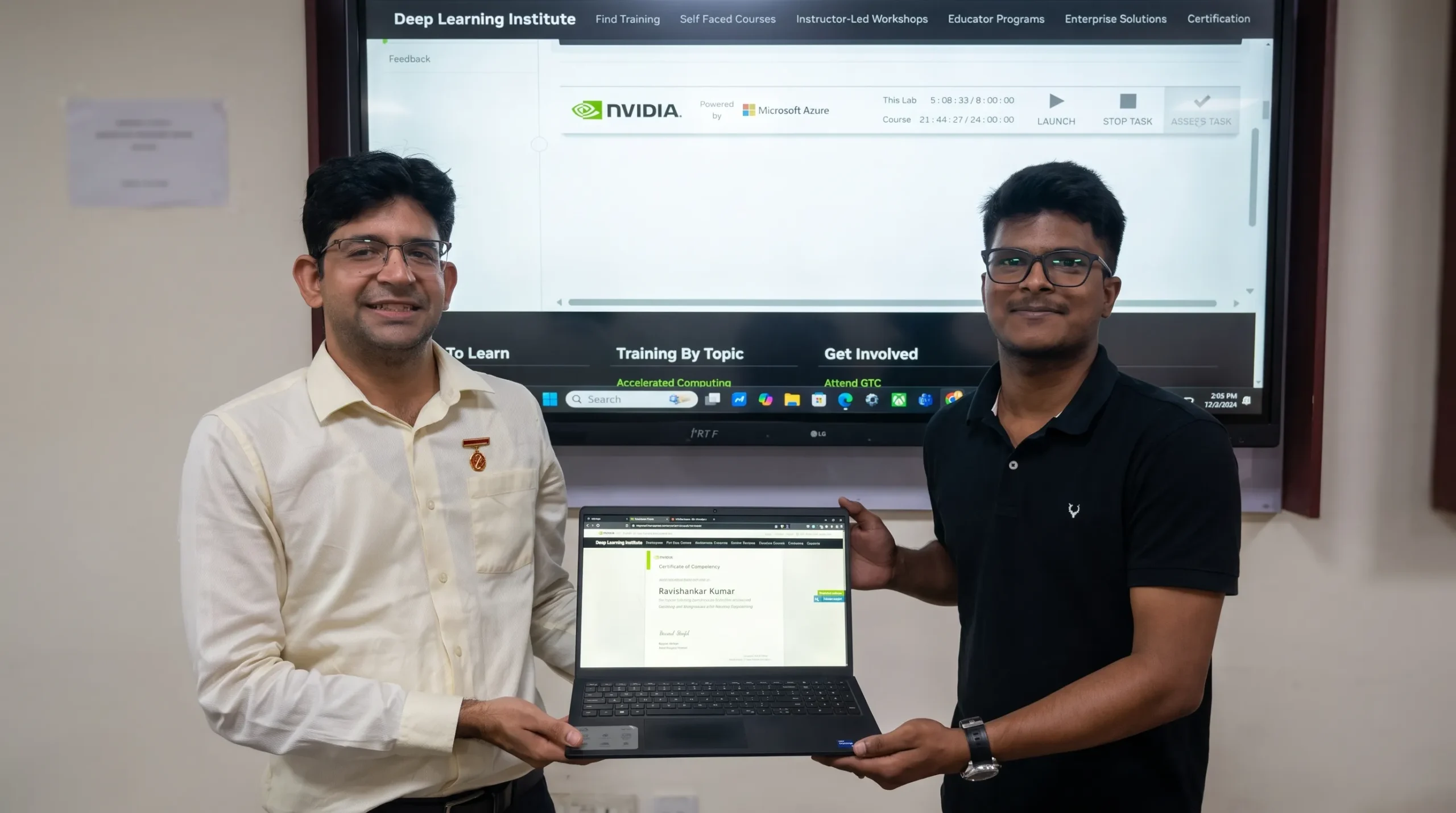
Yes. On completion, participants receive a co-branded certificate issued jointly by PRTF School of Management and CloudThat. The certificate records the programme, the training hours and the practical systems completed during the course.