Future

READY

MANAGEMENT

AI-Centric PGDM Program

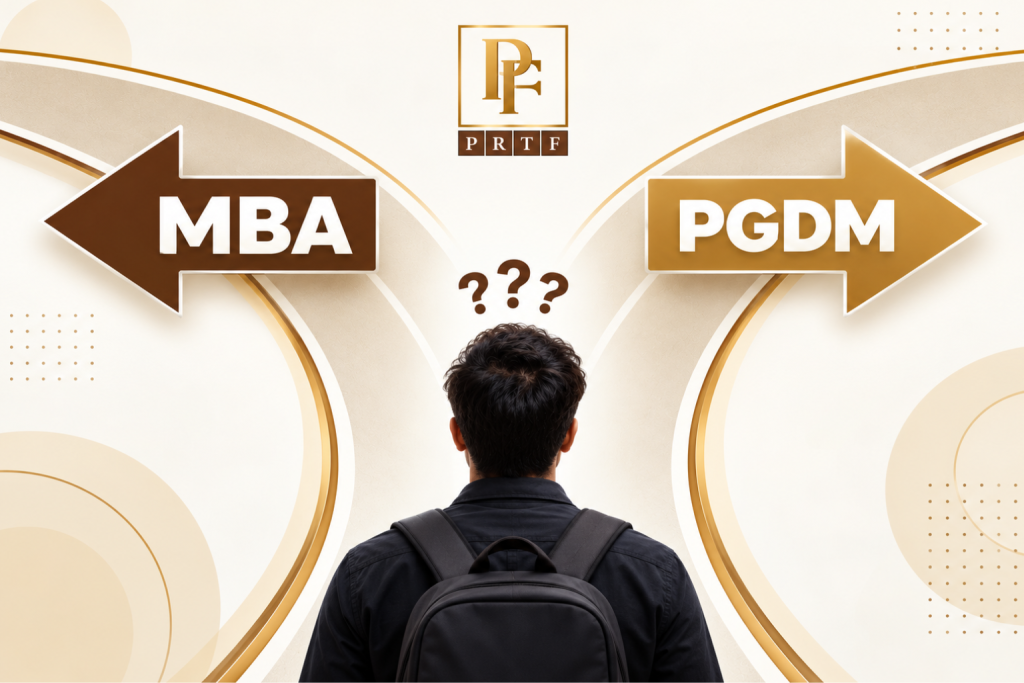
PGDM vs MBA in 2027: Which Fits Your Career, Budget & Goals?

PGDM and MBA are both postgraduate management qualifications, but they differ in how programmes are awarded and can differ in curriculum, fees and academic structure. Neither is automatically better. The right choice depends on the specific institute, programme quality, specialization, cost and your career goals.

Factor PGDM MBA
Qualification Diploma Degree
Offered by Eligible/approved institutions Universities or affiliated institutions
Duration Commonly 2 years for full-time programmes Commonly 2 years in India
Curriculum Depends on institute Depends on university/institute
Fees Varies significantly Varies significantly
Career Scope Management/business roles Management/business roles
Salary Depends on institute, role and candidate Depends on institute, role and candidate

Key Differences Between PGDM and MBA

Understanding the distinction between a Postgraduate Diploma in Management (PGDM) and a Master of Business Administration (MBA) helps students make informed choices based on their career aspirations.

1. Awarding Body & Recognition

An MBA is a degree program awarded by universities or colleges affiliated with universities (governed by UGC). A PGDM is a postgraduate diploma offered by autonomous institutes approved by AICTE.

2. Curriculum Flexibility

Since autonomous institutes design PGDM courses, they can update their syllabus frequently to match emerging industry trends like AI, Business Analytics, and FinTech. MBA curricula are governed by university boards and are updated on a fixed periodic schedule.

PGDM vs MBA Fees Structure

Course fees for both programs vary widely depending on the institution type:

  • Government Universities (MBA): Generally lower tuition costs (e.g., FMS Delhi, state universities).
  • Private Universities (MBA): Moderate to high fee structures depending on infrastructure and branding.
  • Autonomous B-Schools (PGDM): Fees depend on private funding, industry exposure, and campus amenities.

Start Your Management Journey Today!

Join a future-ready PGDM program in Greater Noida and build the skills to lead tomorrow.

Career Scope and Salary Prospects

Corporate recruiters generally do not differentiate between an MBA degree and a PGDM diploma for private-sector roles. Hiring managers prioritize skill sets, practical exposure, internship achievements, and institute reputation over the credential title.

Starting salaries for both PGDM and MBA graduates depend primarily on:

  • Institute tier and placement track record
  • Chosen specialization (e.g., Business Analytics, Finance, Marketing)
  • Individual student performance and prior work experience

Which One Should You Choose?

Consider choosing an MBA if you prioritize a traditional master’s degree for global university recognition, government job eligibility, or higher academic research like a PhD. Consider choosing a PGDM if you are targeting industry-aligned learning, case-study-driven pedagogy, and specialized management roles in the private sector.


Planning to pursue PGDM?
Let’s make it happen!
Get personalized guidance from our admission team and find the right PGDM college for your goals.
Talk to Admission Team
Get Program Details
Understand Admission Process
Make the Right Choice
PRTF PGDM Student

Frequently Asked Questions About PGDM vs MBA

1. Is PGDM better than MBA?
Neither is universally better. PGDM often offers a more dynamic, industry-oriented curriculum updated by autonomous B-schools, while an MBA provides a formal degree awarded by a university. The best choice depends on the specific institute’s reputation, faculty, placements, and curriculum.
2. Is PGDM harder than MBA?
PGDM can feel more intensive because autonomous institutes update their curriculum frequently to include live projects, practical case studies, continuous evaluations, and industry requirements, whereas traditional MBA programs follow fixed university exam patterns.
3. Is PGDM cheaper than MBA?
Not necessarily. Government university MBA programs are usually the most affordable. Top autonomous PGDM colleges may charge higher fees due to privately funded infrastructure, industry exposure, and specialized exposure.
4. Can I complete PGDM in 1 year?
Standard full-time AICTE-approved PGDM programs in India are 2 years long. However, some executive PGDM or post-graduate diploma options exist for candidates with prior work experience that can be completed in 1 year or 15 months.
5. Can I get a job after PGDM?
Yes, PGDM graduates are eligible for management and business roles across private and corporate sectors. Job opportunities depend on your skills, specialization, practical experience, internships, and the institute’s placement network.
6. What is PGDM salary per month?
Monthly starting salaries vary widely based on institute tier, candidate skills, specialization, and job location. Entry-level starting packages generally range from ₹35,000 to ₹80,000+ per month, with significantly higher pay at top-tier B-schools.
7. Is PGDM equivalent to MBA?
In the corporate job market, recruiters treat PGDM and MBA as equivalent qualifications. For academic or higher education purposes (such as pursuing a PhD or studying abroad), a PGDM program may require AIU (Association of Indian Universities) equivalence status.
8. Which has better career scope, PGDM or MBA?
Both offer similar career scope in corporate management, consulting, finance, marketing, and analytics. Scope is driven by the institute’s placement track record, your skill set, and industry exposure rather than the title of the qualification.
9. Can I pursue a PhD after PGDM?
Yes, you can pursue a PhD or Fellow Programme in Management (FPM), provided your PGDM program is recognized as equivalent to a master’s degree by AIU or accepted by the specific university offering the doctorate.
10. Which should I choose: PGDM or MBA?
Choose an MBA if you prefer an affordable university degree, plan to pursue government jobs, or aim for higher academic research. Choose a PGDM if you prioritize an industry-driven curriculum, practical case studies, and corporate roles in private sectors.

Share this link via

Or copy link