When most management students hear ‘AI in retail’, they picture a sleek mobile application sending a generic push notification coupon. They do not picture a multi-billion-dollar global coffee giant using localized reinforcement learning models to predict individual store inventory down to the last milk carton, optimizing supply chain logistics across thousands of locations while dynamically determining the exact square footage of a new neighborhood layout.
If you finish your MBA or PGDM program without understanding this shift, not just as a consumer-facing app feature but as a core overhaul of operational infrastructure, you will spend your management career catching up to those who do.
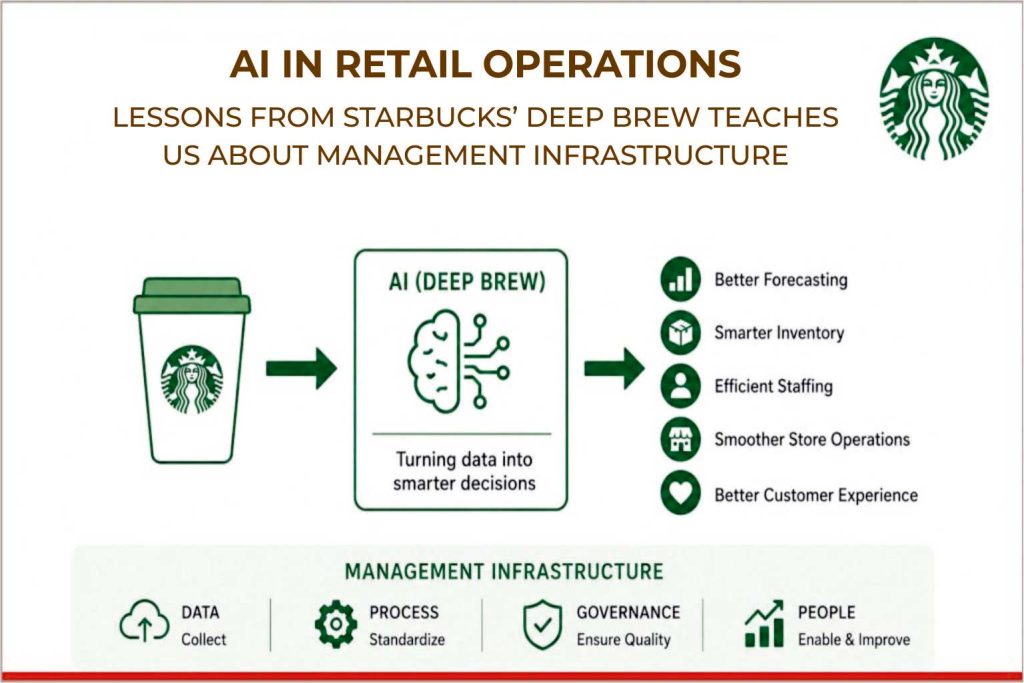
The most instructive AI stories are not about deploying the most sophisticated, ultra-complex models. They are about organizations that spent years building the foundational data infrastructure that gives those models something meaningful to work with. At Starbucks, that operational backbone is an initiative called Deep Brew.
For Indian management students entering an economy where 88% of companies now use AI in at least one business function, the lessons from Starbucks’ Deep Brew are not optional reading. They are foundational. This case study, drawn from PRTF School of Management’s ongoing exploration of AI in business management, explains what an AI-Centric PGDM program teaches you to see in cases like this, and why the gap between curriculum and industry reality matters more than ever.
What you will learn through this guide
By the end of this blog, you will understand:
- The architecture of Deep Brew: How Starbucks shifted from isolated data silos to a centralized algorithmic engine.
- Operational vs consumer AI: Why hyper-local inventory and real-time labor scheduling matter more than generic recommendation algorithms.
- The data infrastructure prerequisite: Why algorithms fail without a clean, institutional data pipeline.
- Where AI stops and the manager begins: Defining the boundary between algorithmic output and human leadership.
- What this means for your PGDM: How an AI-Centric PGDM program, such as the one offered at PRTF School of Management, prepares you to think about cases like this from Term I.
The case study: From isolated silos to Deep Brew
For decades, traditional retail market research and operations looked straightforward: look at quarterly historical sales, run a regional forecast, order stock, and hope your store managers adjust schedules based on foot traffic.
Starbucks flipped this paradigm by treating every single storefront not as an isolated cafe but as a data-generating node in a unified edge-computing ecosystem. Launched under the leadership of their technology teams, Deep Brew was designed from day one to be a core operational engine rather than a marketing gimmick.
1. Hyper-local personalization and predictive inventory
The Deep Brew engine doesn’t look at broad regional trends; it looks at hyper-local parameters. It cross-references an individual store’s historical order frequencies with real-time local weather patterns, regional calendar events, and inventory constraints.
- The result: If a sudden heatwave hitting a specific district spikes the demand for cold brews by 30%, the algorithm dynamically flags the supply requirement before the store manager even opens the morning ledger, mitigating stockouts and reducing waste.
2. Algorithmic store layouts and real estate selection
When traditional retail brands look to open a new location, they look at broad demographic metrics or high-level foot traffic. Deep Brew handles the heavy lifting of location intelligence by analyzing specific micro-corners. It maps transaction-per-square-foot projections, calculates the impact on nearby existing stores (cannibalization metrics), and suggests spatial designs optimized for that specific neighborhood’s pickup versus dine-in ratios.
3. Automated labor scheduling
One of the highest points of friction in retail operations is matching labor hours to customer waves. Deep Brew continuously updates predictive demand patterns throughout the day. By automating the logistical forecasting of how many baristas are needed on the floor at 7:30 AM versus 10:00 AM, it frees store managers from administrative scheduling grids.
Three structural shifts in retail management
Starbucks’ implementation demonstrates that the true value of AI in management rests on three structural shifts. These shifts define what an AI-Centric PGDM program needs to teach in 2026 and beyond.
Shift 1: From model sophistication to infrastructure readiness
Many companies fail with AI because they try to deploy advanced neural networks onto fragmented, messy data environments. The lesson from Deep Brew is clear: the companies that extract the highest ROI from AI are those that spent years cleaning their data pipelines, integrating point-of-sale (POS) systems, and ensuring real-time data flow. Infrastructure always precedes intelligence.
Shift 2: From national strategy to neighborhood precision
India, like any massive consumer market, is not a monolith. A strategy that works in a commercial hub in South Delhi will fail in an educational zone in Greater Noida. Deep Brew proves that modern management requires hyper-localization. Algorithms allow an international brand to operate with the agility and context of a local neighborhood shopkeeper.
Shift 3: From administrative time to human connection
The ultimate goal of retail automation is not to replace the human workforce but to elevate it. By handling repetitive analytical tasks like counting inventory, running spreadsheets, or calculating labor schedules, the algorithm gives the store manager the freedom to do what machines cannot: lead.
Where the algorithm stops and the leader begins
An AI-Centric PGDM or MBA program teaches you never to view an algorithm as a flawless oracle. Deep Brew demonstrates, with unusual clarity, exactly where the AI stops and the leader must step in:
‘The algorithm can tell you which corner is likely to generate the most transactions per square foot. It cannot tell you whether this is the right corner for your brand in this neighborhood at this moment in time. It can tell you what a customer ordered on her last seventeen visits; it cannot tell you whether she would prefer you to remember her name or give her space this morning.’
Those are management decisions. They require empathy, cultural awareness, and strategic vision. Deep Brew handles the data crunching so that a manager actually has the time, space, and clarity to think about them.
This is exactly the kind of manager the Indian job market is hiring in 2026. The kind who can validate algorithmic output, override it when judgment demands, and translate the data into a decision the algorithm could never make alone.
How PRTF’s AI-Centric PGDM program connects to this case
Case studies like Deep Brew are not abstract reading material in the classrooms of PRTF School of Management. They are the lens through which the AI-Centric PGDM program is designed.
In the first trimester of PRTF’s PGDM program, students study foundational AI concepts alongside core management subjects, the integration that makes a case like Starbucks’ Deep Brew legible. By the time students reach specialization in year two, they are working hands-on with the same families of tools, recommendation engines, predictive analytics platforms, generative AI for business research, that power systems like Deep Brew.
The capstone projects, undertaken in the final two trimesters of the PRTF PGDM program, often replicate the structure of a Deep Brew deployment in miniature: identify a real business problem, build the data pipeline, deploy an AI-augmented solution, measure the result, and document the limits. This is what produces graduates who can walk into a recruiter’s interview and discuss AI in business with concrete, applied vocabulary, not just abstract enthusiasm.
Starbucks did not become an AI-augmented company by hiring AI specialists. It became one by training managers to think in AI-augmented ways. That is the kind of manager PRTF’s AI-Centric PGDM program is built to produce.
Management field exercise: Put this into practice
To truly master this concept before your next operations or technology management class, complete this quick real-world field exercise. This kind of applied learning is the foundation of what an AI-Centric PGDM program at PRTF emphasizes from Term I.
- Visit a local retailer or food franchise. Walk into a high-foot-traffic retail store, quick-service restaurant, or local franchise outlet in your area.
- Interview the store manager. Ask them three specific questions:
- How do you decide your daily inventory ordering levels?
- How much time do you spend creating employee work schedules every week?
- What data or digital tools do you wish you had access to in real time to make your day easier?
- Write a one-page operational insight memo. Map out how a centralized data engine like Deep Brew could optimize their specific friction points. Be prepared to present your findings on how data infrastructure changes frontline management roles.
The conclusion
Starbucks is not, at its core, an AI company. It is a hospitality company that made a series of management decisions, some technical and many organizational, that turned its accumulated customer relationships and operational data into a strategic asset of remarkable power.
The lesson for Indian business students is not to replicate Deep Brew. Most organizations operate at different scales, with different data environments and different competitive dynamics. The lesson is to recognize the pattern: the companies that extract the most value from AI are not the ones deploying the most sophisticated models. They are the ones that spent years building the data infrastructure that gives those models something useful to work with, and the ones that designed their organizations to translate algorithmic outputs into better decisions.
This is exactly the orientation that PRTF School of Management’s AI-Centric PGDM program is built to develop. Not AI for its own sake. AI as the foundation of how a modern Indian manager thinks, decides, and leads.
Go build something.
Next steps
- Download the PGDM 2026 brochure for the complete curriculum, fee structure, admission timeline, and faculty details of PRTF’s AI-Centric PGDM program.
- Apply for admission to PRTF’s PGDM program. Admissions for the 2026 to 2028 batch are now open.
- Talk to our admission team by calling 8860005458 for personalised guidance on the AI-Centric PGDM program, curriculum, and admission support.
Related guides you may find useful
- What is an AI-Centric PGDM program? The foundational guide to AI-Centric PGDM education in India.
- AI in business management, an overview of how AI is reshaping management roles in Indian companies.
- AI, management and market research in India, a deep dive into how Indian businesses use AI for consumer insight.
- PGDM fees in Delhi NCR 2026, a transparent breakdown of programme costs at PRTF and across Delhi NCR.
Written by
Aman Rajput, who is a highly motivated Data Science postgraduate student at Dhirubhai Ambani University with strong expertise in AI/ML, data engineering, and NLP-driven applications. He is currently working as a Data Engineer at Simform and has previously gained hands-on industry experience at Adani Industry Cloud, where he developed LLM-powered solutions including PDF-GPT, CSV-GPT, and SQL-GPT using OpenAI APIs and LangChain. His projects demonstrate proficiency in Retrieval-Augmented Generation (RAG), sentiment forecasting, recommender systems, and scalable ETL pipelines using technologies such as PySpark, TensorFlow, Hugging Face, and Streamlit. Aman has also earned notable academic and professional achievements, including a merit-based scholarship, Microsoft Power BI certification, and recognition for publishing widely used datasets on Kaggle.