
Looking for PGDM admission 2027 in Greater Noida? The Post Graduate Diploma in Management (PGDM) is a two-year management programme for graduates who want to develop their business, leadership and entrepreneurial skills.
At the PRTF School of Management, Pathfinder Research and Training Foundation, the AI-centric PGDM combines management education, artificial intelligence and entrepreneurship. The programme is designed for students interested in understanding business through practical learning, AI applications and venture development.
This guide covers PGDM eligibility, the admission process, entrance examination requirements, programme fees and the distinctive learning opportunities available at PRTF for the 2027–29 batch.
Explore the Programme: Visit the Official PRTF Website »
PGDM Admission 2027: Eligibility Criteria
1. Educational Qualifications
Candidates interested in PGDM admission in Greater Noida should hold a bachelor's degree from a recognised university, subject to the programme's applicable eligibility requirements. Graduates from disciplines such as B.Com., B.Tech., BBA, B.Sc. and B.A. can check their eligibility with the admissions team.
- Minimum Graduation Marks: Refer to the official PRTF admission guidelines for the applicable minimum percentage and eligibility conditions.
- Final-Year Students: Candidates awaiting their graduation results should confirm whether provisional applications are accepted and when their final documents must be submitted.
- Required Documents: Keep academic records, identification documents, photographs and entrance examination scorecards ready, as applicable.
2. PGDM Admission Without CAT
Candidates who have not appeared for CAT can contact PRTF to confirm the accepted entrance examinations and available alternative assessment routes. Any profile-based shortlisting, internal assessment or interview must follow the institute's official admission policy.
Applying without CAT does not automatically guarantee admission. Candidates should confirm the current selection criteria before submitting their applications.
Step-by-Step PGDM Admission Process
Students planning to apply for PGDM admission 2027 at PRTF should review the official programme information and follow the prescribed application procedure.
- Online Registration: Visit the official PRTF website and complete the application form with accurate personal and academic details.
- Application Review: The admissions team reviews applications according to the applicable eligibility requirements and selection policy.
- Entrance Examination and Assessment: Provide an accepted entrance examination score, if required. Shortlisted candidates may be asked to attend an interview or other assessments specified by the institute.
- Admission Offer: Selected candidates receive instructions regarding document verification, fee payment and confirmation of admission.
Ready to apply? Visit PRTF for 2027–29 Admission Information »
Accepted Entrance Exams and PGDM Cutoffs 2027
Entrance examination requirements and selection criteria can vary by institute and admission cycle. Candidates should confirm directly with PRTF whether CAT, MAT, CMAT or another assessment is accepted for the 2027–29 PGDM batch.
| Entrance Exam | Conducting Body | Cutoff / Requirement |
|---|---|---|
| CAT | IIMs | Confirm the current requirement with PRTF |
| MAT | AIMA | Confirm acceptance and selection criteria |
| CMAT | NTA | Confirm acceptance and selection criteria |
| Alternative Assessment | As specified by PRTF | Check the official admission policy |
Do not rely on unofficial cutoff estimates. Check the latest admission disclosure and contact the institute for the applicable selection requirements.
PGDM Fees and Important Admission Dates 2027–29
Before choosing a PGDM college in Greater Noida, compare the total programme cost, accommodation expenses, payment schedule and refund policy. Request the latest official PRTF fee structure before making any payment.
- Programme Fees: Confirm the applicable tuition fees and additional charges.
- Application Deadline: Check the official admissions portal for current deadlines.
- Batch Commencement: Confirm the scheduled start date for the 2027–29 batch.
- Payment and Refund Policy: Review the official terms before confirming your seat.
PGDM Admission with Startup Incubation: Join the Founders’ Cohort
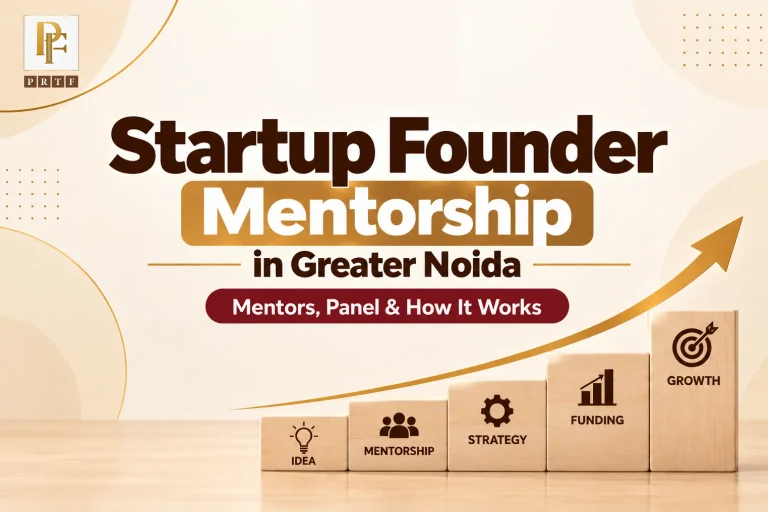
Most business schools prepare students for a corporate career. The PGDM at PRTF does that too, and adds a second track: every student in the 2027–29 batch, our first, builds a venture alongside the degree. That makes the batch a founders’ cohort. Everyone in it is taking a real problem to a working product and then to a company, together.
Learn Among People Who Are Building
Startup questions rarely have textbook answers. How do you price something nobody has bought yet? When is an idea validated enough to build? What does registering a company actually involve? On the founder track, you ask the people who have faced those questions themselves.
- Classmates building alongside you. Your batch is solving the same kinds of problems at the same pace, so every conversation in the corridor is a working session.
- Founders in the room. Sessions with founders are part of the track from Term I. You hear what went wrong and what they would do differently, not only what worked.
- Mentors who have done it. Eight weeks of mentorship start you off. A panel of experienced leaders reviews your venture at the end of the first year.
- An incubator on the same campus. Eighteen ventures have been incubated at the PRTF Startup Hub. The people building them work a short walk from your classroom.
How the Founder Track Runs
- Term I · Idea. Eight weeks of mentorship, from finding a problem worth solving to a validated idea and a pitch.
- Term II · MVP. A minimum viable product tested with real users, with a revenue model and a go-to-market plan behind it.
- Term III · Company. Investment, team, finance and company formalities, ending in front of the panel that selects startups for incubation.
What Selected Startups Get
Startups chosen by the panel move into the PRTF Startup Hub for six months of formal incubation, extendable to a year after a performance review. They get mentors, co-working space on campus, legal and marketing support, seed support for ventures that clear the panel, and help preparing for fundraising and accelerator programmes. Your work on the founder track can also earn credits and marks.
👉 Explore the Ecosystem: Read More About India's Founders Cohort Program & Startup Incubation Admission »
Start from Zero. Leave Able to Lead with AI.
You don’t need a background in technology. No maths is assumed and no coding is assumed. Every core course in the first year carries an AI layer, and it grows term by term, so the skill builds up the way management judgement does: by using it.
- Term I · AI literacy. What AI is, how to use it and why it matters for business. Hands-on from day one, built by doing.
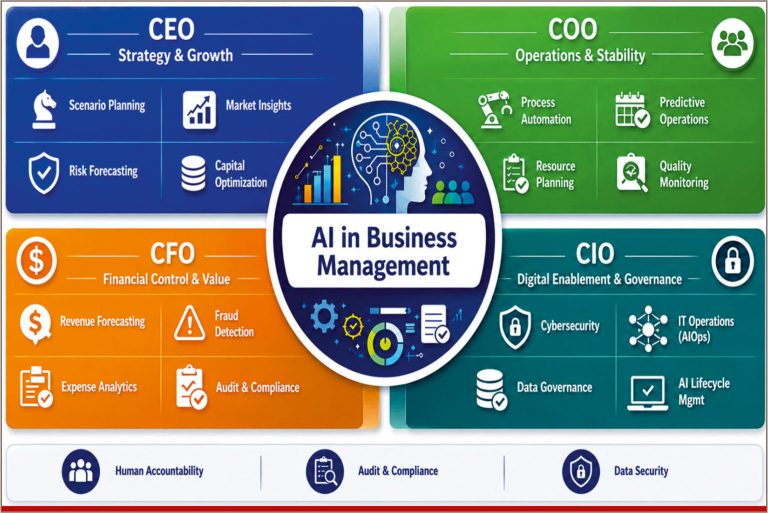
- Term II · AI application. Marketing, finance, operations and HR each gain an AI-application layer. AI stops being a separate subject and becomes the lens through which you practise management.
- Term III · AI strategy. Making AI-strategy decisions, leading AI implementations and governing AI ethically. You finish with a real AI-consulting engagement for an actual organisation, and a portfolio piece to show for it.
Across all three terms you also earn industry certifications and training from leading AI and technology companies.
Where the Two Tracks Meet
The AI layer and the founder track run side by side, term for term. The term you learn to apply AI is the term you build your MVP. The term you learn AI strategy is the term you turn your venture into a company. You learn to lead a business built on AI by building one.
👉 Explore the AI-Centric PGDM: Read More About the PRTF PGDM Programme »
Who It Suits
It suits you if you want to start a company while you earn your management degree, or if you want to learn business, and AI, by using them, whatever your background. You don’t need to have coded before or to have run a business. The programme is designed to take you from your first prompt to leading AI decisions, and from your first idea to a company.
Why Consider PRTF for PGDM in Greater Noida?
When comparing PGDM colleges in Greater Noida, students should evaluate the curriculum, faculty, campus facilities, programme fees, industry exposure and career support.
PRTF highlights three areas of learning: AI-centric management education, entrepreneurship through its Startup Hub, and industry-oriented learning opportunities. Students interested in combining management skills with AI and venture development can explore these features while comparing their options.
- AI-Centric Learning: Explore how AI is applied to management disciplines.
- Entrepreneurship: Learn about venture development and startup incubation opportunities.
- Industry Exposure: Review the available training and certification pathways.
- Greater Noida Campus: Visit the campus and assess its facilities before making a decision.
Campus Location: 30/7–8, Knowledge Park III, Greater Noida, Uttar Pradesh 201308.
Frequently Asked Questions About PGDM Admission 2027
1. How can I apply for PGDM admission 2027 in Greater Noida?
Visit the official PRTF website, review the admission requirements and complete the application process according to the current instructions for the 2027–29 batch.
2. What is the eligibility for PGDM admission at PRTF?
Candidates should review the current programme eligibility guidelines and confirm the applicable graduation requirements with the admissions team.
3. Can I apply for PGDM without CAT?
Alternative entrance examinations or assessment routes depend on the institute's current admission policy. Contact PRTF to confirm the available options before applying.
4. What are the fees for the PRTF PGDM programme?
Request the latest official fee structure and confirm tuition, additional charges, payment deadlines and refund conditions.
5. Does the PRTF PGDM include AI education?
PRTF describes its programme as AI-centric management education. Review the current curriculum to understand the AI learning activities, practical projects and certification opportunities.
6. Does PRTF offer startup incubation?
PRTF has a Startup Hub and highlights entrepreneurship as part of its ecosystem. Confirm the current incubation eligibility, selection process and support terms with the institute.
7. Where is PRTF located?
The PRTF School of Management is located in Knowledge Park III, Greater Noida, Uttar Pradesh.
Apply for PGDM Admission 2027–29 at PRTF
If you are planning to pursue PGDM admission 2027 in Greater Noida, compare eligibility requirements, entrance exam criteria, fees and programme features before making your decision.
Explore PRTF's AI-centric management education, founders' cohort and startup ecosystem to determine whether the programme aligns with your academic and career goals.
Take the Next Step: Visit the Official PRTF Website »
Contact Admissions: Contact PRTF for Admission Guidance »