
There is a quiet mismatch running through Indian higher education right now, and almost every final year student discovers it at the same moment, sitting in a placement interview, being asked a question their syllabus never prepared them for.
The question is rarely “what is cloud computing.” It is closer to “walk me through how you would design a highly available architecture across multiple tiers,” or “show me something you have built with an LLM,” or “how would you model this dataset in BigQuery.” These are not theory questions. They are questions about work, and they are answered convincingly only by people who have actually done the work on the actual platforms.
That is the gap PRTF’s training vertical was built to close.
What your degree covers, and what it does not
A well-designed undergraduate or postgraduate curriculum teaches you fundamentals that hold their value for decades: data structures, statistics, database theory, management principles, systems thinking. None of that is wasted. It is the foundation everything else sits on.
What a university curriculum structurally cannot do is keep pace with the platforms industry actually runs on. Syllabi are revised on multiyear cycles. AWS ships hundreds of service updates a year. Google Cloud’s analytics stack looks materially different than it did eighteen months ago. Generative AI tooling, meaning the model APIs, the orchestration frameworks, the agent patterns, did not exist in a teachable form when most current syllabi were approved.
So, the average graduate arrives in the job market knowing what a virtual private cloud is, without ever having configured one. Knowing that companies use data warehouses, without having queried a table at terabyte scale. Knowing that AI is transforming business, without having written a single production grade prompt or wired a model into a working application.
Hiring managers can tell the difference in the first ten minutes of a technical conversation. And in a market where a single cloud engineering opening attracts hundreds of applications, that ten minutes is the whole interview.
Why certification became the filter
Recruiters cannot verify a video playlist. They cannot verify “familiar with AWS” on a CV. What they can verify, in seconds, is a credential issued by the platform vendor itself.
This is why certifications like the AWS Certified Solutions Architect Associate have become a default screening criterion across cloud and data roles in India. It is not that the certificate itself performs the job. It is that the certificate is a standardised, independently verifiable signal that someone has been assessed against a published blueprint by the company that built the platform. In a stack of two hundred CVs, a verifiable credential is a sorting mechanism, and candidates without one frequently do not reach the human review stage at all.
For working professionals, the same logic applies at a different pressure point. Internal promotions into cloud, data, and AI functions increasingly require demonstrable platform competence. A credential plus a portfolio of built systems is what moves an application from “interested” to “qualified.”
The technologies we teach are the technologies the frontier runs on
PRTF’s training catalogue is built deliberately around the platforms that the leading AI and cloud organisations actually operate on, not around simplified teaching environments or generic cloud computing curricula.
Amazon Web Services underpins a substantial share of global production infrastructure, and is the platform on which a large proportion of enterprise AI workloads are deployed. Google Cloud operates the analytics stack, including BigQuery, Looker, and Dataform, used across data driven organisations worldwide, alongside its Gemini based assistive tooling. Anthropic’s Claude and OpenAI’s models are the frontier systems that engineering teams are building products on right now. NVIDIA’s Deep Learning Institute curriculum reflects the tooling used by teams working directly on GPU accelerated AI systems.
These are not adjacent technologies. They are the working surface of the industry, and the participants who learn them learn them on live infrastructure, not simulations.

Delivered by certified trainers, on official curriculum
This distinction matters more than any other in this article.
PRTF’s flagship certification programmes are delivered in association with CloudThat, an authorised training partner for AWS and Google Cloud, and are offered alongside NASSCOM and FutureSkills Prime. Instruction is carried out by platform certified trainers, meaning practitioners who hold the credentials they are teaching towards and who deliver the official vendor courseware.
Three consequences follow from that arrangement:
The courseware is the official curriculum. Vendor partner terms require official content to be delivered in full and unmodified. Participants receive the same material an enterprise team in Bengaluru or Singapore receives, not a summarised interpretation of it.
Lab environments are provisioned, not improvised. Practical labs run on the vendor’s managed infrastructure. Participants do not need a paid cloud account, and they are not practising against screenshots.
The instructor has done the job. Certified trainers bring the failure modes, cost traps, and architectural judgement that no courseware document contains, which is the difference between knowing a service exists and knowing when not to use it.
Depth over duration: what the curriculum actually covers
Every programme in the catalogue is measured in instructional hours, because hours are what determine depth. A programme that compresses cloud architecture into a handful of sessions is not the same product as one that gives foundational modules the classroom time they need.
Flagship on campus certification programmes
Architecting on AWS · 45+ hours
The official AWS classroom track behind the AWS Certified Solutions Architect Associate (SAA-C03) blueprint. Covers core AWS services, networking and VPC design, storage and database selection, security and identity management, high availability and fault tolerance, cost optimisation, and the Well-Architected Framework. Includes seven practical labs on live AWS infrastructure, building up to a capstone in which participants design and deploy a highly available application architecture themselves. Participants receive an exam voucher benefit covering 50% of the SAA-C03 examination fee.
Data to Decisions: Official Google Cloud Track · 40+ hours
A sequential consolidation of three official Google Cloud courses into a single progression: BigQuery for Data Analysts, Analyzing and Visualizing Data in Looker, and Generative AI Leader. Participants move from querying and transforming very large datasets in SQL, through building governed data models and dashboards in Looker, to understanding how generative AI is applied on top of an organisation’s own data. Covers Dataform pipelines, Connected Sheets, Looker Studio, and the assistive capabilities in BigQuery Studio.
Future-ready skills with OpenAI · 35+ hours
An eight-module practical programme taking participants from a basic account to genuine working fluency. Structured around applied use, covering research, analysis, writing, automation, and workflow design, with labs and activities in every module. No prerequisites. The premise is that AI tooling complements existing professional workflows rather than replacing them, and the programme is built to make that concrete rather than aspirational.
Claude101: The Modern AI Stack · approximately 30 hours
A build led programme for participants who can already write Python. Across a sequence of live build sessions, participants construct working systems on the modern AI stack, covering model APIs, structured output, tool use, retrieval, and agent patterns, and leave with a complete codebase they own and can extend. The certificate is issued jointly by PRTF and CloudThat. It is a record of what was built, and the codebase on your laptop is what carries weight in an interview.
Building LLM Applications with Prompt Engineering · 10 hours
An intensive on the applied LLM engineering stack: LangChain and LCEL workflows, structured output with Pydantic, tool use, and LLM agents. Delivered by an NVIDIA DLI Platinum Instructor.
Online and self paced tracks
Offered in association with NASSCOM and FutureSkills Prime, for participants who need to build foundations or specialise around existing commitments:
- AWS data analytics, 13 hours
- AWS AI practitioner, 12 hours 25 minutes
- AWS machine learning, 10 hours
- Generative AI fluency, 10 hours
- Acquiring data, 10 hours
- Algorand blockchain application developer, 9.5 hours
- Digital application fundamentals (STEM), 6 hours
- Exploratory data analysis, 5 hours
The full catalogue is available at pathfinderfoundation.co.in/training.
Weekday and weekend batches
Every flagship programme runs in two parallel cohorts.
The weekday cohort is designed for students, with full day immersive sessions that make use of the fact that a student’s calendar can accommodate sustained, uninterrupted depth.
The weekend cohort is designed for working professionals, delivering the identical curriculum, the identical labs, and the identical certification pathway without requiring anyone to take leave from their job. Same trainers, same courseware, same credential.
This is a deliberate structural choice. Upskilling that requires you to choose between your career and your training is upskilling most people cannot actually do.
The campus is part of the programme
Comprehensive training is not only about curriculum. It is about whether the environment lets you concentrate for a full day and whether the infrastructure holds up when forty people launch cloud labs simultaneously.
- Learning environment. Fully air conditioned smart classrooms with high definition projection and interactive interfaces, designed for full day sessions rather than hour long lectures.
- Computing infrastructure. High performance IT and AI innovation labs with a dedicated server room supporting heavy data processing and AI modelling workloads.
- Connectivity and continuity. A high speed fibre optic network spanning the campus, with 24 hour power backup, because a lab session that drops mid deployment is a lab session lost.
- Knowledge centre. A hybrid library with management and technical literature, global electronic journal subscriptions, industry reports, and case studies, available as a quiet zone between sessions.
- Digital learning and podcast studio. A dedicated content creation suite, including a podcast facility used for recording industry insight sessions.
- Meals and refreshments. Lunch and refreshments are included daily, in an open and covered cafeteria. One less thing to plan around during an intensive programme.
- Residential facilities. On campus hostel accommodation is available for outstation participants on a payment basis.
- Recreation and breakout spaces. Common rooms and discussion areas for the parts of learning that happen between sessions.
- Safety and support. Round the clock security with CCTV surveillance and trained personnel, and on call emergency health services with tie ups to leading local medical facilities.
- Seminar halls and conference rooms. Professional venues for corporate interfaces and guest sessions.
Participants also receive a full PRTF welcome study kit, access to the PRTF mentorship network, and support from the institution’s placement assistance cell.
On price: what this actually costs elsewhere
The single most common objection we hear is that vendor certified training is out of reach financially. That objection is well founded, for most of the market.
Instructor led AWS bootcamps from Indian training providers commonly range from ₹15,000 to ₹50,000. NIIT, through RPS Consulting, lists its Architecting on AWS instructor led programme at ₹35,000 plus GST. Classroom AWS training in metro cities is frequently quoted at around ₹30,000, with live online delivery at roughly ₹25,000. Google Cloud’s own instructor led engagements are priced in training units at enterprise rates. And these figures are for the training alone. The certification examination is billed separately, with the SAA-C03 costing in the region of ₹12,500 to ₹15,000 including GST.
PRTF’s pricing sits deliberately below that band:
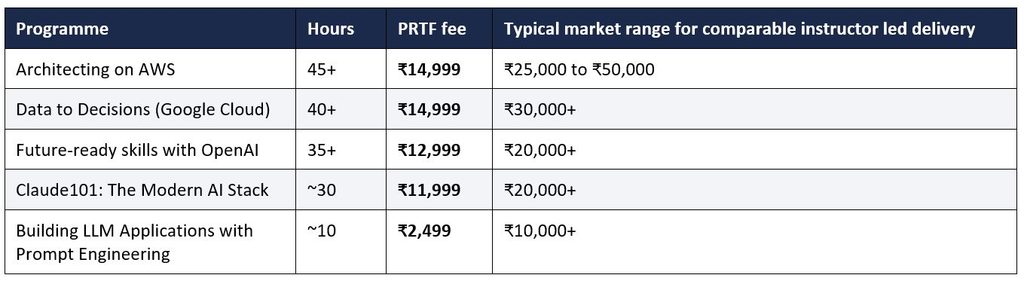
On the AWS programme that works out to under ₹340 per instructional hour, inclusive of certified trainer delivery, official courseware, managed lab infrastructure, the 50% SAA-C03 exam voucher, daily meals, and full campus access. There is no separate lab fee, no separate materials fee, and no bundled subscription you continue paying for after the programme ends.
Self paced video courses cost more than this with no instructor in the room, no live lab environment, and no credential pathway. That comparison, rather than any discount framing, is the honest case for the price.
All fees exclusive of GST unless stated. Certification examination fees, where applicable, are paid separately to the vendor.
What this changes for you
If you are a student: you graduate with something on your CV that your classmates do not have and that a recruiter can verify without calling anyone. More importantly, you graduate with systems you have actually built and can talk about in detail. When the interviewer asks what you have deployed, you have an answer that is specific.
If you are a working professional: you acquire a credential that maps directly to the roles your organisation is hiring into, without stepping away from your current one. Cloud, data, and AI competence is the layer sitting beneath most technical career paths right now. It compounds across every subsequent role rather than expiring with a single technology cycle.
For both: the differentiation is not the certificate on its own. It is the combination of a verifiable credential, practical delivery on real infrastructure, and a portfolio of built work. Any one of those alone is common. Together they are rare, and hiring managers notice.
A note on honesty, because it matters: no training programme can guarantee a job, and PRTF does not make that claim. What we provide is rigorous instruction on the platforms employers are hiring for, credentials the market already recognises, and dedicated placement assistance through our institutional cell. The outcome depends on what you build with it.
Enroll
Browse the full catalogue and programme details at https://pathfinderfoundation.co.in/training/
Pathfinder Research and Training Foundation
30/7-8, Knowledge Park III, Greater Noida, Gautam Budh Nagar, Uttar Pradesh 201308
Phone: +91 8860005458 | contact@pathfinderfoundation.co.in
PRTF is an AICTE approved institution. Certification programmes are delivered in association with CloudThat, an authorised AWS and Google Cloud training partner, and offered in association with NASSCOM and FutureSkills Prime. AWS, Amazon Web Services, Google Cloud, BigQuery, Looker, NVIDIA, OpenAI, and Claude are trademarks of their respective owners, referenced in the context of authorised training delivery. PRTF does not guarantee employment or salary outcomes.